COMBAT LOAD TRAINING
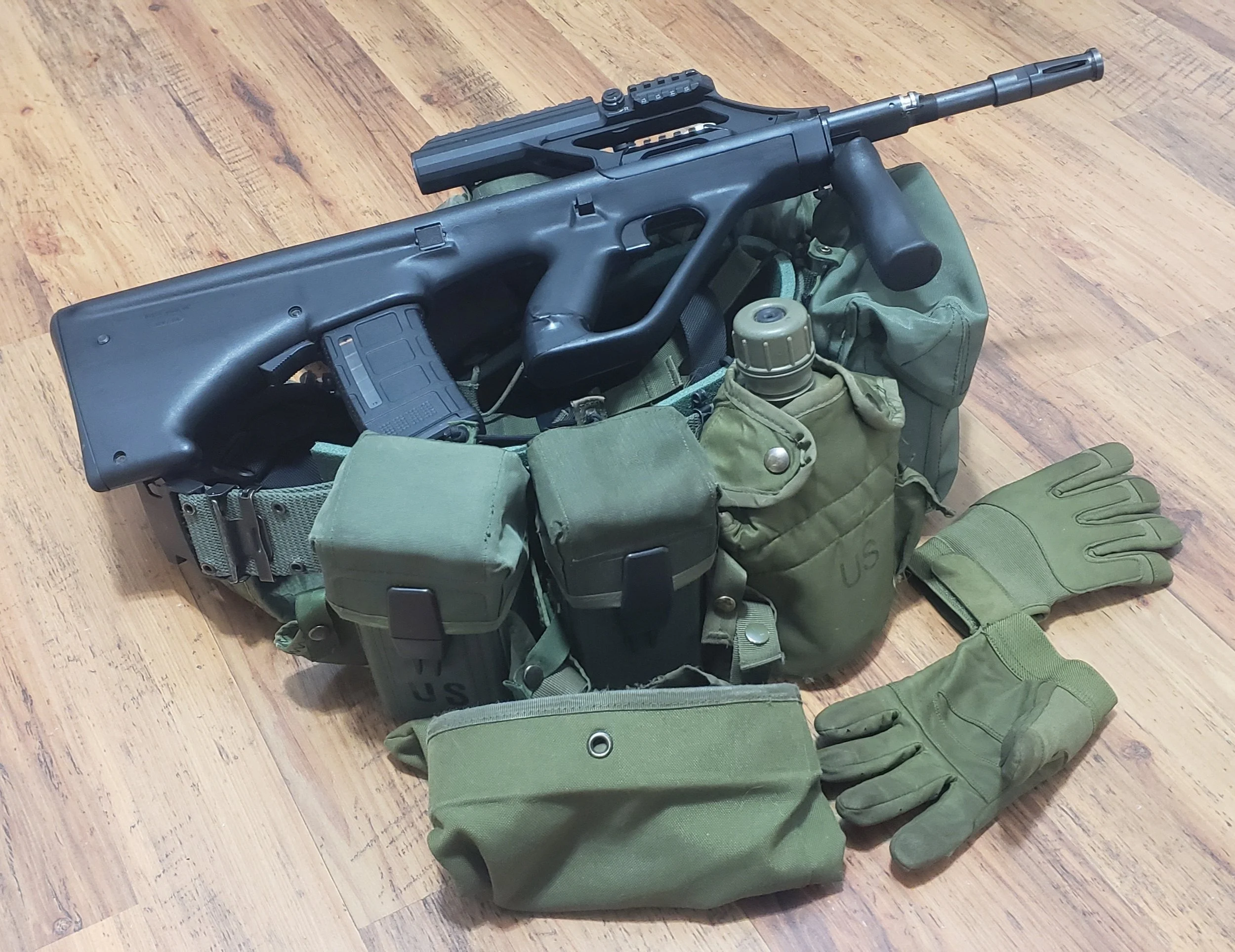
When I was in the military, we did most of our training slick or slow. Rarely did we perform training or practice with a full combat load on unless we were on the range and doing a dry rehearsal, which was rare. I get the concept of training slick, but I found it to be a painful experience just having to deal with the strain of a full load in combat. Practicing running or carrying a load for a long time would have prepped my body a lot better, I feel. I think it is vital to isolating and developing the muscular structure to support the specific movements needed in order to maneuver efficiently and effectively fight with a full combat load. Speed and endurance are vital characteristics, so practice it and work on it.
GEAR SELECTION
To get an idea about how you should attack this issue, I would recommend first looking at the gear that you are looking at using to fight with. While you are doing this, I want you to keep in mind the realities of combat. The hardest things you will have to do in combat is evacuating a casualty under fire and locating the enemy. This means that it is likely that you will be doing a bit of responding to incoming fire with blind fire in hopes of it having a suppressive effect. This takes ammunition, which is life, along with maneuverability. Many people seem to think something like 5 magazines is just about enough to provide effective fire in an engagement. This is an ignorant thought for civilians. Consider the fact that in a civilian or militia setting, you are on your own and you will rarely have the luxury of dominating the AO. This means that if you get in contact, you are on your own. You will have to fight your way out of it yourself, which takes time and ammunition. With that, you will also need the endurance and strength to last through the fight, which brings me to the heart of this article. You need to set up a reasonable loadout for establishing combat sustainability and work with that load to build endurance and efficient maneuverability.
One of my favorite things to do is to use a backpack during calisthenics, jogs, or walks, and load it with roughly 20-30 pounds of water This mimics the weight burden you will feel on patrol all the time. Plus, when you start using this in calisthenics, you really start getting an idea of what it is like to have to move around with that kind of weight. Another option is to wear a weight vest that is at least 15 pounds. This would be good for agility work like ladder drills, burpees, changing positions, jumping, etc. It will help develop that fortitude in your joints and tendons to withstand the strain of the aggressive change of direction.
TARGETTED TRAINING
When patrolling, a lot of what you are going to be doing is walking through different terrain and going to different positions for security. These types of movements are going to strain your core and back, as well as your glutes and quadriceps. Also, when fighting, you can be expected to get up and down, or side to side quickly, as well as leaning and holding a static aiming position for a duration. This will mean that you are going to have to get your core and legs accustomed to powerful short duration bursts and isometric positions with weight that force stability of the back, core, and shoulders.
I highly recommend doing high weight kettlebell swings and adopting the Quick and the Dead power protocol. This will build your power in your legs and glutes, and give you a “what the hell” effect due to how well it also builds your conditioning. Kettlebell swings are all about developing strength endurance, and are used by athletes all around the world to help build power and endurance in the posterior chain. It is not for those who want to bulk up, but rather those who aim to max out their performance capability. There are terrific coaches for kettlebell swing technical development, such as Geoff Neupert with Chasing Strength.
I found a great amount of practical development in my overall robustness and conditioning by adopting Stew Smiths Pyramid training (1 pullup, 2 pushups, 3 air squats, 2 Sandbag Push press) with distance running (200 meters) between sets. The normal pyramid is a 1-10-1. You multiply the reps by the set number you are on, so on set 2, you would do 2 pullups, 4 pushups, 6 air squats, 4 SB push press, and then run 200 meters. You will go up the pyramid to set 10 (10 pullups, 20 pushups, 30 squats, 20 SB push press, 200 meter run) and then go down the pyramid. This system allows a warmup and a cooldown, all in one. Also, the volume you acquire is fantastic. If you do the entire pyramid, you will accrue 100 pullups, 200 pushups, 300 squats, 200 SB push presses, and you will have run 3800 meters/2.5 miles. This whole session can take 2 hours, in some cases. It is not for the faint of heart.
BUILDING TECHNIQUE
First thing I recommend you do is to mimic the movements you will be using in combat. Simple things like taking a kneeling position behind cover or leaning in a standing position will definitely point out weaknesses initially. The important thing is to see where you are weak and then target that specific area. In cases of a lean out, I recommend setting up a workout by holding out something like a 5-pound dumbbell and leaning out for 30 seconds on each side and do 30 second rests in between sets. Do 4 or more sets of this and do this twice a day.
Other movements that you can expect to perform in combat are quick rushes and position shifts. This will test your agility and power in your core and legs. A way to mimic this technique is to conduct burpees with an empty rifle in your hand. Focus on getting to the prone and aiming your rifle for 5 seconds and then bursting up and performing a high knee jump to slightly replicate the explosive action the legs will be performing when rushing to position. Conduct this exercise 10-15 times with no rest in between reps. Do 3-5 sets of this with a rest of 3 minutes between sets for muscle recovery. The idea is to do more sets for body acclimation.
The last technique I will discuss is aiming isometrics. Aiming and stability with holding out weight is a highly neglected aspect of combat training in my experience. I think it would be wise to not only perform isometrics with a rifle and pistol, but to do it with a bit of weight added to really stress the shoulder muscles and core, resulting in the real thing feeling like a kid’s toy when it comes time to performing live fire or dry fire training. I set this up by setting a timer on my phone for 45 seconds or a minute. I then fill up a 2 qt canteen and suspend it around the middle of my rifle, or wrists if using a pistol. I find a tiny target on the wall and establish an aggressive firing stance. The aim is to keep the gun motionless using the sights as a reference. Do 6 sets of this with a rest time between sets matching the time you performed the exercise.
CONSISTENT TRAINING SCHEDULE
It is important to get your body accustomed to having more weight. However, I recommend starting out by doing it every other day in order to prevent injury. As you increase the weight or sets, you can either do a few sets daily or increase the sets to provide a consistent healing schedule for your muscles. It is up to you, but I also recommend taking in foods and spices known to have anti-inflammatory characteristics such as garlic and turmeric with black pepper. This will help with healing and overall reducing the risk of injury through strain.
When it comes to training, consistency outperforms intensity every time. Pushing yourself to the limit in a single session may feel impressive, but it won’t build lasting skills. Regular, focused practice creates muscle memory, sharpens decision-making, and enhances overall readiness. Adaptive Combatives & Tactics values steady progress—small, repeated efforts that compound over time. This ensures you develop confidence and competence without burnout. Gear and tactics are tools, but it’s consistent training that turns tools into life-saving habits. Choose consistency. Train smart, train often, and watch yourself evolve. That’s how you stay ready when it counts.
WRAPUP
Combat Load PT isn’t just about physical conditioning; it’s about realistically simulating real-world scenarios where you will be required to wear a full fighting or combat load. By incorporating essential gear such as backpacks, tactical vests, and simulated or heavy weapon systems, both soldiers and civilians can train more effectively for situations in which endurance, strength, and mobility are absolutely crucial. Emphasizing functional strength over mere muscle bulk allows individuals to develop the specific capabilities necessary to meet the demanding physical challenges encountered in modern warfare and high-stress self-defense environments.