THE 1940S MILITARY CALISTHENICS PROGRAM THAT BUILT THE TOUGHEST GENERATION
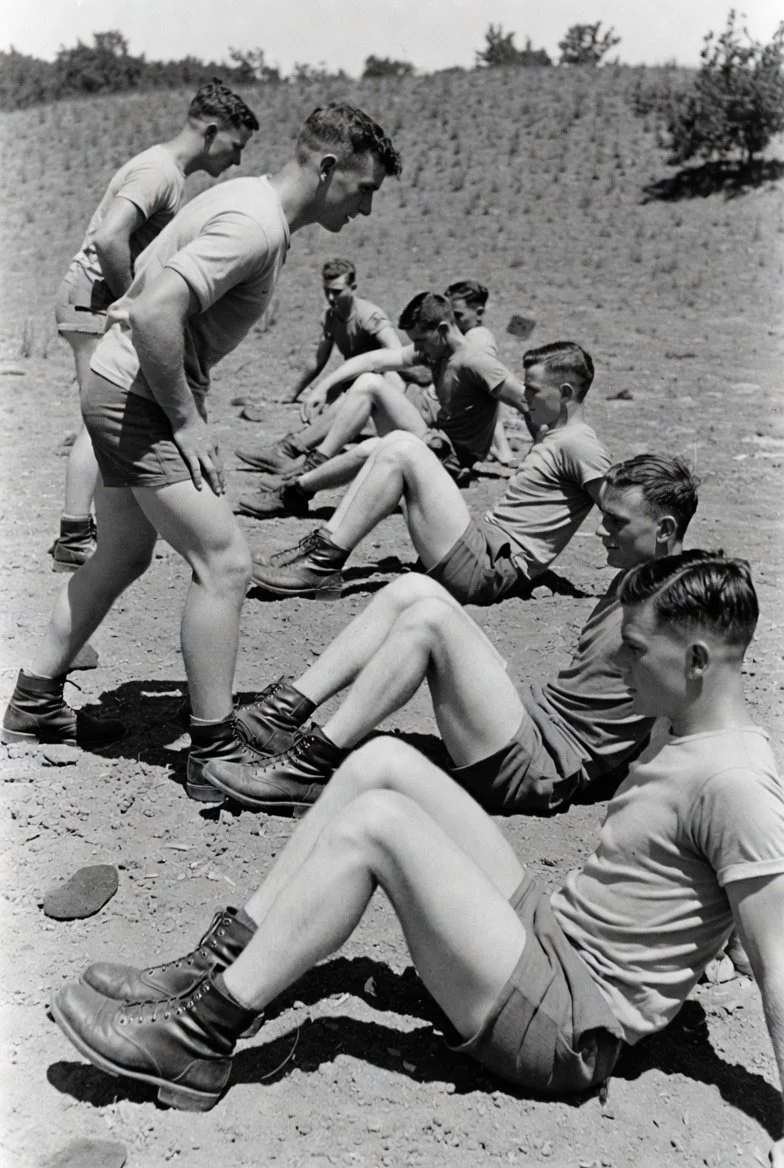
Zero equipment. Brutal conditioning. The forgotten system that turned boys into war-ready machines in weeks.
In 1942, a 19-year-old farm boy from Iowa stepped off a train at Fort Benning weighing 138 lbs soaking wet. Eight weeks later he could run 5 miles in boots, carry a 190-lb man through a mud pit like it was nothing. He didn’t touch a barbell once. No creatine. No gym. Just dirt, gravity, and a drill instructor who believed pain was the fastest teacher.
This wasn’t CrossFit. This wasn’t some influencer’s “300” workout. This was the standard U.S. Army calisthenics program used across every branch from 1941–1945. They called it “Physical Training.” We would call it absolutely savage. The result? An entire generation of men (many barely out of high school) who were stronger, leaner, and more resilient than any steroid-fueled bodybuilder you see on Instagram today.
The program was buried after the war when chrome gyms and Nautilus machines became the new religion. Until now. What follows is the exact progression, the daily drills, the forgotten intensity techniques, and the conditioning finishers used to turn civilians into the toughest fighting force the world has ever seen.
No equipment. No excuses. Just results measured in combat readiness.
Welcome to the 1940s Military Calisthenics Program. The system that built the Toughest Generation.
TRAINING CIRCULAR 87 & WAR DEPARTMENT PAMPHLET #21-9
In the grueling theaters of World War II—from the scorching deserts of North Africa to the muddy trenches of Europe and the dense jungles of the Pacific—the success of American soldiers hinged not only on superior firepower and tactics but on their raw physical resilience. Marching endless miles under heavy packs, scaling obstacles under fire, engaging in brutal hand-to-hand combat, and enduring days without rest demanded bodies forged for endurance, strength, agility, and unyielding stamina. Recognizing the softening effects of modern mechanized life on its recruits, the U.S. Army introduced Training Circular 87 (TC 87) in November 1942, a rigorous calisthenics circuit and conditioning regimen designed to transform ordinary civilians into combat-hardened warriors. This program, amplified in the 1944 War Department Pamphlet No. 21-9, "Physical Conditioning," emphasized functional exercises like burpees, guerrilla drills, and grass drills to build the "total military fitness" needed for victory.
THE HISTORY
The roots of TC 87 trace back to a long military tradition where physical fitness was seen as essential to battlefield success, as ancient empires like the Persians, Greeks, and Romans demonstrated through rigorous conditioning that propelled their conquests—until luxury eroded their prowess and led to their downfall. In the U.S. Army's own history, early 20th-century programs drew from figures like Herman Koehler at West Point, who emphasized gymnastics and calisthenics in his 1919 manual, and Joseph Raycroft's 1920 "Mass Physical Training," which incorporated WWI lessons like obstacle courses and efficiency tests. However, the interwar period (1919–1939) bred complacency; with a small peacetime Army and limited funding amid the Great Depression, training manuals like Training Regulations No. 115-5 (1928) and Basic Field Manual 21-20 (1936) focused on basic health and morale through gymnastics, bayonet drills, and mass athletics, but standards were lax, and societal shifts toward urban jobs and labor-saving technologies left American youth increasingly unfit.
The outbreak of World War II exposed these deficiencies starkly. The Selective Training and Service Act of 1940, the first peacetime draft, examined over two million men, rejecting nearly half—one million—for physical unfitness, including issues like poor endurance, strength, and coordination. This crisis prompted urgent reforms under Army Chief of Staff General George C. Marshall, who prioritized "physical hardening" to prepare draftees for mechanized warfare's demands, such as long marches, tank operations, and assaults. In 1941, the War Department issued Field Manual (FM) 21-20, "Physical Training," the first manual dedicated solely to fitness, outlining calisthenics, running, obstacle courses, and swimming to build combat readiness, with tests like the Combat Obstacle Course Test (OCT) featuring hurdles, walls, and crawls. It recommended five weekly high school PE sessions to bolster civilian fitness, though adoption was uneven.
By 1942, reports from theaters of operation and the Army Ground Forces (AGF) revealed troops' needs for more strenuous activities, as initial training proved inadequate for real-world stresses like desert treks and jungle fights. In response, Colonel Theodore Paul "Ted" Bank, a WWI veteran and athletics expert, led a controlled study testing 25 fitness assessments on over 400 soldiers, collaborating with exercise scientists like Charles McCloy and A.A. Esslinger. The research identified key events (e.g., pull-ups, burpees, push-ups, 300-yard run) and demonstrated a 23.5% fitness improvement in experimental groups versus 3.5% in controls. This outcomes-based approach culminated in TC 87, "Physical Training," published on November 17, 1942, as a supplement to FM 21-20. TC 87 introduced a progressive regimen with calisthenics circuits (15 exercises targeting all muscle groups), guerrilla and grass drills for agility, combatives for aggressiveness, running for endurance, and ruck marches, emphasizing variety to prevent monotony and build "total military fitness" (technical, mental/emotional, physical).
CALISTHENICS EXERCISES IN TRAINING CIRCULAR 87
Training Circular 87 (TC 87), issued by the U.S. War Department on November 17, 1942, and amplified in the 1944 Pamphlet No. 21-9, outlined a core set of 13 calisthenics exercises designed to build strength, endurance, agility, and coordination for soldiers. These bodyweight movements were to be performed in sequence, starting slowly and progressing to a continuous flow as fitness improved. Each exercise targeted specific muscle groups while promoting overall combat readiness. Repetitions increased over time, typically aiming for 6-12 per exercise in early stages, with a moderate cadence unless noted. Benefits, as described in the manual, focused on functional military fitness. Substitutes were provided for variety or adaptation.
Below is a detailed breakdown of the exercises, drawn directly from TC 87.
The High Jumper
Starting Position: Feet separated about 12 inches, knees slightly bent, arms raised backwards, body bent slightly forward at the waist.
Cadence: Moderate.
Movement:
(1) Swing arms forward and jump upward.
(2) Swing arms backward and jump upward.
(3) Swing arms forward and over head vigorously and leap upward at least 12 inches.
(4) Swing arms backward and jump upward.
Benefits: Essentially a warm-up exercise. It is a total body movement involving the legs, arms, and trunk. This exercise also develops coordination.
Burpee
Starting Position: Attention.
Cadence: Moderate.
Movement:
(1) Bend slightly at the knees and sharply at the hips; place hands on the ground in front of the feet in a squat position with the elbows inside the knees.
(2) Thrust feet and legs backward to a front leaning rest position with body straight from shoulders to feet, weight supported on hands and toes.
(3) Return to the squat position.
(4) Resume standing position.
Benefits: One of the best exercises to develop agility. It reaches and strengthens primarily the muscles of the trunk, thighs, and hips. It also serves as an additional warm-up exercise.
Squat Bender
Starting Position: Standing with feet slightly separated and arms in a loose thrust position.
Cadence: Moderate.
Movement:
(1) Full squat, thrust arms forward, fingers extended, palms down, keep trunk erect.
(2) Return to original position.
(3) Bend forward sharply, thrusting downward with fingers touching toes if possible, knees straight.
(4) Return to starting position.
Benefits: Strengthens the heavy muscles of the legs and thighs as well as the trunk forward-bending musculature. It has excellent postural benefits. When the knees are kept straight in the forward bend the exercise has a limbering and loosening effect upon the hamstring muscles.
Rowing Exercises
Starting Position: Flat on back, arms extended overhead, feet together.
Cadence: Slow to moderate.
Movement:
(1) Sit up and at the same time bend knees sharply; lean forward, thrusting or swinging arms forward to a rowing position with the knees together and against the chest, feet flat on the ground and heels close to buttocks; arms extended forward.
(2) Return to starting position.
Benefits: Strengthens the abdominal muscles. In addition, it is one of the best exercises to reduce the waist line. The leg extensor and flexor muscles are also exercised.
Substitute (4a: Mountain Climber):
Starting Position: Squatting position with right leg extended to the rear, knee straight, and left leg drawn up against the chest.
Cadence: Fast.
Movement: (1) Extend left foot backward and bring the right leg under the chest. (2) Return to the starting position.
Benefits: Strengthens the heavy extensor and flexor muscles of the thighs. It has a massaging effect upon the abdomen which aids in reducing the waist-line.
Pushups
Starting Position: Front leaning rest. The body is straight from head to heels.
Cadence: Moderate or at will.
Movement:
(1) Bend elbows and touch chest to ground, keeping body straight.
(2) Straighten elbows raising body in straight line.
Benefits: The purpose of this exercise is to strengthen the arm and shoulder extensor muscles.
Situps
Starting Position: Flat on back, feet apart sideward about two feet, arms extended overhead.
Cadence: Slow.
Movement:
(1) Sit up, thrust arms forward and touch toes, knees straight.
(2) Lie back to original position.
(3) Raise legs, swinging them over head, keep knees straight, touch toes to ground behind head.
(4) Lower legs to starting position, slowly.
Benefits: Strengthens the muscles of the abdomen, thighs and hips. It also stretches the hamstring muscles which aid in the development of suppleness and flexibility. The massaging effect on the abdominal viscera is very beneficial.
Substitute (6a: The Woodchopper):
Starting Position: Feet about two feet apart, trunk turned left, hands clasped together, arms thrust over left shoulder, head facing front.
Cadence: Moderate.
Movement: (1) In a chopping movement, bend the trunk forward, bringing arms down vigorously between legs. Bend knees. Extend arms as far behind legs as possible. (2) Raise the trunk and assume the same position as in the starting position but with the trunk turned right and hands over the right shoulder. (3) Repeat the first movement. (4) Resume the starting position.
Benefits: Strengthens the muscles of the trunk and abdomen. It also stretches the hamstring muscles and has a stretching and massaging effect on the abdominal viscera.
Side Bender
Starting Position: Standing with feet apart about 2½ feet, hands clasped overhead, arms straight.
Cadence: Slow.
Movement:
(1) Bend sideward sharply to the left, bending the left knee. Bend straight to the side, do not twist the torso or shoulders.
(2) Recover slightly and repeat.
(3) Recover and repeat.
(4) Return to starting position. Same exercise on right side on counts of 5,6,7 and 8.
Benefits: Has the effect of exercising the lateral musculature of the trunk. This exercise also develops suppleness and coordination.
Bank Twist
Starting Position: Flat on back, arms extended sideward, palms down, legs raised to a right angle with feet together, knees straight.
Cadence: Slow.
Movement:
(1) Lower legs to the left, twisting the torso, touching ground on left side in vicinity of left hand. Keep knees straight.
(2) Return to the starting position.
(3) Lower legs to right, twisting torso, touching ground on right side in vicinity of right hand. Keep knees straight.
(4) Return to starting position.
Benefits: Strengthens the oblique abdominal muscles which no other exercise in the series reaches. It also has a very beneficial effect upon the abdominal viscera.
Substitute (8a: The Bridge):
Starting Position: From a sitting position with arms extended backward and legs extended forward with feet flat on the ground, the body is raised upward until the full weight is borne on hands and feet.
Cadence: Slow.
Movement: (1) Arch the back by thrusting the waist upward and the head backward. (2) Return to the starting position.
Benefits: Strengthens the arms and shoulder muscles primarily. It also reaches the muscles of the lower back, thighs, and legs.
Squat Jump
Starting Position: Full squat with left foot forward about 8 inches. Hands clasped on top of head.
Cadence: Moderate.
Movement:
(1) Spring upward from this squat until knees are straight and both feet have left the ground. Change the position of the feet, the right foot becoming the forward foot and the left the rear. Drop to squat on the left heel.
(2) (3), (4) Jump and alternate feet.
Benefits: Strengthens the heavy muscles of the legs and limbers up the joints of the hips, knees and ankles. It brings about a greater flexibility and agility in the legs.
Trunk Twister
Starting Position: Standing with feet about 2 feet apart sideward, with hands clasped behind head, elbows held backward, chin in.
Cadence: Slow.
Movement:
(1) Bend and bounce downward, knees straight. Recover slightly. Do this vigorously.
(2) Bounce downward, but simultaneously rotate trunk sharply to left.
(3) Same to the right.
(4) Return to original position, pulling head back and chin in strongly.
Benefits: Reaches and strengthens all muscles of the trunk. It has excellent postural benefits. It results in greater flexibility of the lower back region.
Stationary Run
Starting Position: Standing with arms in loose thrust position.
Cadence: Slow fast, slow.
Movement: Stationary run. Begin slowly (counting only on left foot). Speed up somewhat, raising knees to height of hips, then run at full speed, raising knees hard, then slow down.
Benefits: Develops cardio-respiratory endurance. While it reaches most of the body except the arms its primary effects are upon the heart and legs.
Eight Count Pushups
Starting Position: Attention.
Cadence: Moderate.
Movement:
(1) Bend slightly at the knees and sharply at the hips and place hands in front of feet in squat position.
(2) Thrust feet and legs backward to a front leaning rest position with the body straight from shoulders to feet, weight supported on hands and toes.
(3) Touch chest to ground.
(4) Return to front leaning rest position.
(5) Touch chest to ground.
(6) Return to front leaning rest position.
(7) Return to squatting position.
(8) Return to starting position.
Benefits: Strengthens the arm and shoulder extensor, trunk bending and leg muscles.
Straddle Pullups (Recommended supplementary exercise)
Starting Position: Men working in pairs. One lies flat on his back with arms stretched upward (palms facing away from him). His partner stands astride his shoulders grasping hands of the supine individual.
Cadence: Moderate.
Movement:
(1) Keeping body straight from shoulders to heels and supporting weight on heels, the body is pulled up as high as possible. Fingers should be hooked into palms and fingers of the upright individual.
(2) Keeping the same position the body is then lowered to the ground.
Benefits: Strengthens the arm and shoulder flexor muscles.
These exercises formed the foundation of TC 87's calisthenics circuit, often followed by guerrilla drills for added agility. I recommend trying out just the minimum repetitions of this circuit.
This circuit will challenge your stability, balance, and rotation if you are new to functional calisthenics. There is a functional 12-week progression to the repetitions of these exercises and culminates in the Physical Fitness Test that many YouTube influencers take without training for it. The results typically speak for themselves.
THE SCIENCE BEHIND ITS EFFECTIVENESS
Modern science seems to corroborate that it is best to move in a variety of ways for as long as possible. This circuit does this by moving the entire body in all planes of motion and challenging it in each exercise. I personally found all the exercises to be relatively easy on the minimum recommended repetitions. Each week, you are doing more repetitions and doing it all in less time, building strong neural connections to the patterns of movement, which is essential for fascia development and adaptation.
The twelve-week time that is used to help build these troops followed a progressive overload model that was logical and allowed the bodies to adapt to the strain. The first weak was all about getting the troops to learn the movements and coach them in their form so that they could perform them perfectly. The pamphlet stressed the importance of perfect form for ideal development. This is how the body likes to learn and grow. It prefers to adapt to things it will do constantly. If you are always doing odd novel exercises without consistency, the body will always think that exercise was a one-off fluke and not create an adaptation. Bodybuilders use this basic principle by rotating through exercises periodically to change the stimulus and continue the hypertrophic response. But think about it; what if you had an exercise circuit that hit all muscles and all planes of motion and your body adapted to that high intensity circuit? You’d have a pretty solid foundation of bodyweight mastery.
GUERILLA EXERCISES
Guerrilla exercises, introduced in TC 87 (November 1942) and detailed in War Department Pamphlet No. 21-9 (May 1944), were high-intensity, rapid-response drills designed to develop agility, coordination, and explosive power. Unlike traditional calisthenics, these were non-cadence, free-form movements (HENCE THE TERM “GUERILLA”) performed at full speed in response to verbal commands, simulating the unpredictable demands of battle—ducking under fire, leaping into foxholes, rolling under obstacles, or sprinting to cover. They were conducted after calisthenics to elevate heart rate and reinforce functional fitness.
Execution Guidelines:
No cadence = Leader shouts commands unpredictably.
Full effort = Soldiers move with maximum speed and power.
Duration = 3 to 5 minutes initially, progressing to 10+ minutes.
Formation = Circle or scattered; allows 360° movement.
Warm-up required = Always follow calisthenics.
Progression = Start with 3–4 exercises, add more as conditioning improves.
Core Guerrilla Exercises
1. Forward Roll
Command: "Forward Roll – GO!"
Movement:
From standing, drop into a squat.
Tuck chin to chest, place hands shoulder-width on ground.
Roll forward over one shoulder (alternating sides), keeping body compact.
Come up to a squat or standing position, ready for next command.
Benefits: Develops tumbling ability, shoulder strength, and spatial orientation. Essential for diving under wire or into cover.
Combat Application: Rolling under barbed wire, diving into trenches during artillery fire.
2. Backward Roll
Command: "Backward Roll – GO!"
Movement:
1. Squat deeply, hands behind hips.
Roll backward over one shoulder, tucking chin.
Use momentum to return to squat or standing.
Benefits: Strengthens core, improves balance, teaches recovery from falls.
Combat Application: Rolling downhill or recovering after being knocked down.
3. Fireman’s Carry Pickup (Partner Drill)
Command: "Pickup Your Man – GO!"
Movement:
Partner lies prone.
Lifter squats, grabs under arms or around chest.
Lifts partner across shoulders in fireman’s carry position.
Stands fully, then lowers partner safely.
Benefits: Builds leg, back, and grip strength; teaches casualty evacuation.
Combat Application: Dragging wounded from battlefield under fire.
4. Crawl (Low or High)
Command: "Low Crawl – GO!" or "High Crawl – GO!"
Movement:
- Low Crawl: Belly on ground, elbows and knees propel forward, rifle across arms.
- High Crawl: On elbows and knees, body low but not touching ground.
Benefits: Strengthens arms, shoulders, core; improves stealth movement.
Combat Application: Advancing under machine gun fire, moving through tall grass.
5. Leapfrog
Command: "Leapfrog – GO!"
Movement:
Soldiers pair up, one crouches.
Partner places hands on back, vaults over.
Lands in crouch; roles reverse.
Continue in a chain.
Benefits: Explosive leg power, coordination, timing.
Combat Application: Jumping over obstacles, walls, or fallen comrades.
6. Duck Walk
Command: "Duck Walk – GO!"
Movement:
- Full squat, hands on hips or behind head.
- Walk forward in squat position, thighs parallel to ground.
Benefits: Brutal leg and glute strength; hip mobility.
Combat Application: Moving low in trenches or under low obstacles.
7. Crab Walk
Command: "Crab Walk – GO!"
Movement:
- Sit, hands behind, fingers forward.
- Lift hips, walk on hands and feet (body facing up).
Benefits: Core, triceps, shoulder stability; unusual plane of movement.
Combat Application: Moving under low wire, backward evasion.
8. Sprint Start (from prone)
Command: "Hit the Dirt! … Up and At ’Em – GO!"
Movement:
- On "Hit the Dirt!" → Drop flat to ground instantly.
- On "Up and At ’Em!" → Explode to feet and sprint 10–20 yards.
Benefits: Reaction time, explosive power, cardio-respiratory burst.
Combat Application: Reacting to incoming fire, charging a position.
Sample Guerrilla Drill Sequence (5-Minute Circuit)
Leader circles group, shouts commands rapidly and unpredictably
"Forward Roll – GO!" > 3 rolls
"Hit the Dirt!" > instant drop
"Up and At ’Em – GO!" > sprint 15 yards
"Low Crawl – GO!" > 10 yards
"Leapfrog – GO!" > 3 jumps each
"Duck Walk – GO!" > 10 steps
"Hit the Dirt!" > drop
"Pickup Your Man – GO!" > lift partner
"Crab Walk – GO!" > 5 yards
"On Your Feet – DOUBLE TIME!" > jog in place
Repeat with increasing speed and duration.
TRAINING NOTES FROM THE MANUAL
"The purpose of guerrilla exercises is to develop agility and coordination through rapid changes in body position." (p. 39)
"These exercises should be done with snap and vigor. They are not to be performed in cadence."
"Begin with short periods (3–5 minutes) and gradually increase to 10–15 minutes."
"Use imagination — vary terrain, add obstacles, simulate combat noise."
"Excellent for breaking monotony and instilling aggressiveness."
HOW TO USE THESE
In the manual, it shows a natural progression over a period of 12 weeks to hopefully get you conditioned. I think the best way to use this Training Circular is:
Follow the calisthenics circuit daily for 5 days straight per week and try to get the recommended repetitions on each exercise while achieving immaculate form.
Wear comfortable clothing for the first week or two (while you get a hang of the exercises). Wear utility uniform and boots for the rest of the 12-week conditioning period. (Enhances conditioning)
Include the Guerilla exercises and the running drills (5-10 minutes of high intensity runs), as stated in the 21-9 pamphlet.
Try to limit your exercise, including breaks, to under 60 minutes total.
***If you are not in very good shape, follow the week 1 calisthenics circuit daily and take a minute to recover from each exercise. Practice the exercises you struggle with throughout the day (max effort).
There is an event in the Training Circular called “Grass Drills” that usually followed the Guerrilla exercises. Grass drills were dynamic, ground-oriented exercises adapted from football coaching to foster muscular endurance, agility, coordination, and rapid positional changes. These drills emphasized "driving" through fatigue to simulate combat stresses, teaching soldiers essential skills like dodging, quick drops to the ground, and explosive recoveries. As the manual notes, they develop "a considerable degree of endurance" and should push men to respiratory distress, highlighting their role in building resilience for battlefield maneuvers such as evading artillery or advancing under fire. Unlike calisthenics or guerrilla exercises, grass drills focused on unpredictable high-speed transitions between positions.
You can access the Training Circular yourself if you would like to look over some of the exercises and try to simulate it, if you are really into that sort of thing, but my focus is on the calisthenics and Guerrilla drills in this article.
MY TAKE
I have been fascinated by functional training for quite some time now. I have always felt like traditional exercises and calisthenics was just too linear and stiff. It turns out that the soldiers of WW2 had one of the most holistic and combat oriented training regimens in our history. They were moving a lot in all the planes of motion for a sustained amount of time and practicing progressive overload and high intensity interval training. They were way ahead of their time, and I feel like they were at the peak of functional military fitness. I am not saying that you cannot add weight training to make this a better system, but I think the pamphlet has it right to encourage men to master their bodyweight well before they attempt to master exterior weights like barbells.
I wholeheartedly believe that in the later part of the conditioning schedule, inclusion of things like the Turkish Getup, Windmill, suitcase carries, and medicine ball rotational slams should be added to encourage a more robust core through the twisting and side to side bending. This was the secret sauce to the stability and power that made these guys so robust. Why not bank on that?
WRAPUP
After the war, the military drew down hard and started cutting certain parts of the military, and the physical training principles to be “fit to fight” were cut due to the idea that preparing for war all the time was unnecessary. I personally think this calisthenics circuit and guerilla drills are a terrific system for building a versatile and fit body. Give these a try. Download a copy of the Training Circular for yourself and see the results by sticking with the daily calisthenics circuit and Guerilla exercises within the recommended progressions. I bet you will be impressed by the results.