TC 87 WWII Training: Fix Army Back Injuries & Build Real Warriors 2025
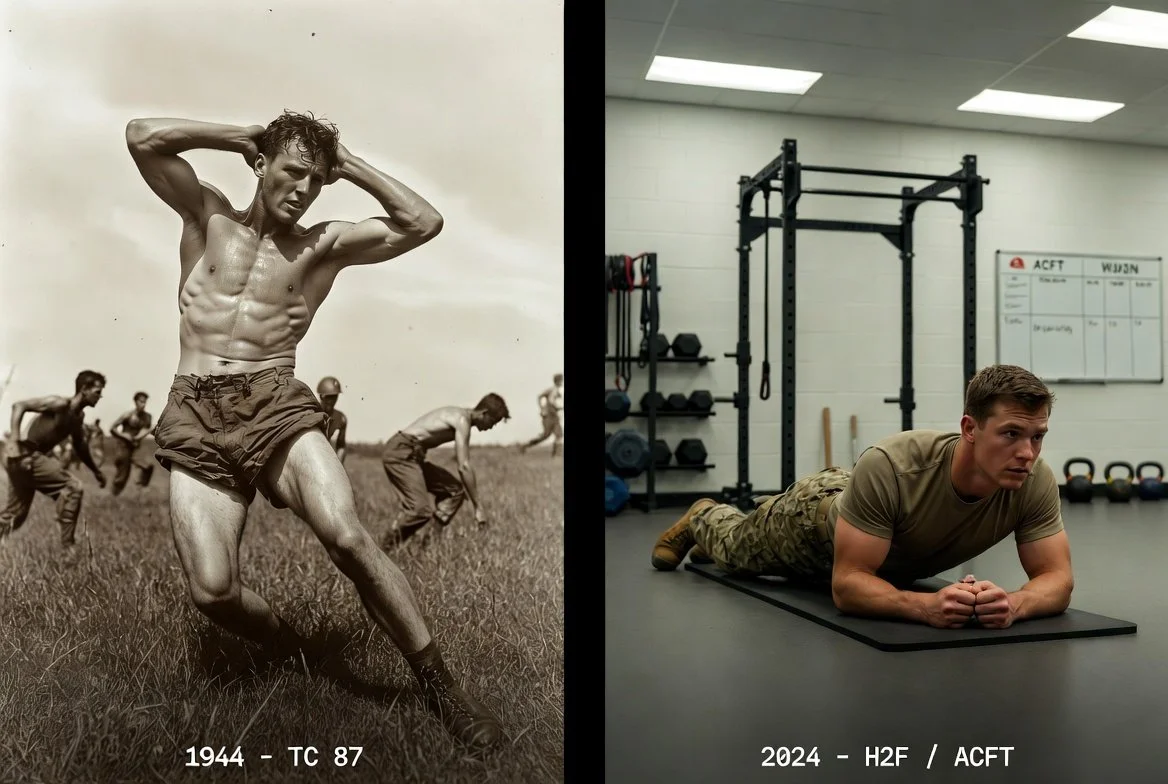
Do you think today's soldiers could survive World War II? The brutal island-hopping campaigns across the Pacific, where men waded through knee-deep soft sand and dense walls of jungle, only to be infiltrated or ambushed at any time? Storming the blood-soaked beaches of Normandy on D-Day, with waves of machine-gun bullets cutting down comrades by the hundreds? Or marching hundreds of miles across war-torn Europe, through blistering cold, constant artillery barrages, and supply lines stretched to the breaking point?
The Greatest Generation didn't just endure—they conquered under conditions that would shatter modern forces. And the secret to their unbreakable grit? Two unassuming military specs: TC 87 and MIL-S-21-9, the rigorous training circulars and standards that forged ordinary recruits into iron-willed warriors capable of feats we can barely imagine today.
TRAINING CIRCULAR 87 AND PAMPHLET #21-9
Training Circular 87 (TC 87), issued on November 17, 1942, represented a pinnacle of World War II-era U.S. Army physical training: a holistic, functional regimen to build comprehensive "total military fitness". Amplified by War Department Pamphlet No. 21-9 in May 1944, it integrated technical, mental/emotional, and physical elements into a progressive program. This training system is what created “the greatest generation”. However, as the war ended and the Army demobilized, the need for battle-ready training waned. This, over time, led to the current brittle generation that cannot fathom how their great grandfathers managed to fight in sustained combat against a peer force, and win. Well, it all starts with the physical conditioning of the individual soldier.
Some feel that the newer Army manual on holistic fitness is a good example of modern science helping soldiers be better. I have heard some argue that the system is truly holistic and “functional” because of some of its odd tests and movements. The issue I see is that the system is based on linear movements and long distance running and neglects everything a body needs to stay functional under load. I aim to show you the evidence of the disfunction and explain why I think we got it all wrong by ignoring the perfect warrior-building training program in TC 87.
THE CHANGE
Timeline of Phasing Out TC 87
Immediate Post-WWII Transition (1946): TC 87 was officially superseded on January 3, 1946, by a comprehensive revision of Field Manual (FM) 21-20: Physical Training. This new FM integrated TC 87's exercises and principles but expanded them into a broader manual covering planning, administration, and a catalog of activities (e.g., rifle exercises, swimming, group games). The 1946 FM marked the end of TC 87 as a standalone circular, folding its content into doctrinal standards for peacetime readiness. By this point, the Army had shifted from wartime urgency to maintaining fitness amid downsizing forces, reducing emphasis on intense, holistic circuits in favor of adaptable group activities.
No Gradual Phase-Out: Unlike modern doctrinal shifts, there was no multi-year rollout or interim guidance. TC 87's obsolescence was abrupt, tied to the Army's reorganization post-V-J Day (September 1945). Distribution ceased, and units were directed to adopt the new FM. Historical records from the Combined Arms Research Library and Library of Congress confirm this as a direct supersession, with TC 87 and Pamphlet 21-9 listed as "obsolete" in the 1946 publication index.
This change aligned with broader Army reforms: The War Department became the Department of the Army in 1947, and physical training evolved to emphasize morale and basic health over combat-specific hardening, reflecting a smaller, professional force.
Shift to "Less Holistic" Exercises
The Army's physical training (PT) doctrine post-1946 gradually moved away from TC 87's integrated, full-body "total fitness" approach—where exercises mimicked battlefield chaos (e.g., rapid positional changes in grass drills)—toward more modular, test-focused, and aerobic-centric programs. This "less holistic" trend prioritized measurable outcomes like running endurance over comprehensive skill-building, influenced by Cold War threats, fitness fads, and administrative efficiencies. Key milestones:
Late 1940s–1950s:
Post-War Priorities: Demobilization (from 8 million to 1.5 million troops by 1947) favored efficient, low-cost PT over intensive circuits.
Modular Expansion and Sports Focus (Less Emphasis on Circuits) FM 21-20 revisions (e.g., 1957 edition) retained some TC 87 elements like calisthenics but de-emphasized guerrilla/grass drills in favor of organized athletics, swimming, and basic conditioning. PT became "modular," allowing units to mix activities based on resources, leading to fragmented training. A 1957 FM highlighted evaluation methods over holistic progression, reflecting post-Korea lessons where endurance (e.g., long marches) trumped agility drills. This era saw a tug-of-war between "systematic group exercises" (holistic roots) and sports/drill, but the latter won for morale in a conscript-heavy Army.
1960s–1970s:
Aerobic Boom and Vietnam-Era Simplification Influenced by civilian jogging trends (e.g., 1970s fitness craze), PT shifted to distance running and basic calisthenics. The 1970s introduced the first Army Physical Readiness Test (APRT, precursor to APFT), focusing on push-ups, sit-ups, and runs—narrow metrics that sidelined TC 87's functional variety. Vietnam experiences highlighted endurance needs but criticized over-reliance on holistic prep, leading to streamlined programs in FM 21-20 updates (e.g., 1974). Training became "less holistic" by isolating components (e.g., cardio separate from strength), with circuits rare outside elite units.
1980s–1990s:
Gender Integration and Test-Driven PT Gender-neutral standards (post-1980s integration) and the 1985 FM 21-20 revision emphasized the APRT/APFT, making PT "test-centric." Bodybuilding and aerobics fads crept in, but doctrine favored repeatable, low-equipment exercises over TC 87's dynamic drills. By 1992, FM 21-20 focused on aerobic/muscular endurance, with circuits optional—marking a low point in holism, as units prioritized passing tests over combat mimicry.
2000s–2010s:
Combat Lessons and Partial Reversal Post-9/11 wars exposed APFT limitations (e.g., poor correlation to load-bearing tasks), prompting TC 3-22.20 (2010), which reintroduced strength/endurance drills akin to TC 87. However, it remained test-focused until FM 7-22 (2012) stressed "physical readiness" but still leaned aerobic.
2020s:
FM 7-22 Holistic Health and Fitness (H2F) (October 2020) replaced the 2012 version and TC 3-22.20, integrating physical, nutritional, mental, and spiritual elements (ACFT, rolled out April 2022) emphasizes more functional strength (e.g., deadlifts, sled drags), but H2F critiques past "industrial-scale" training as overly narrow.
No Solution Visible:
From the 1946 FM 21-20 through the jogging-era 1970s, test-driven APFT (1980s–2010s), and even the “holistic” H2F of 2020, U.S. Army physical training has never recaptured the raw, 3-plane combat chaos of TC 87 and Pamphlet 21-9. Where WW2 soldiers forged indestructible cores through daily Trunk Twisters, Grass Drill flops, and rotational combatives—absorbing real-world impacts without a single “thrown-out back”—modern doctrine prioritizes sagittal lifts (deadlifts, sprints) and static planks while neglecting frontal and transverse planes. Despite adding sleep logs and dietitians, H2F still trains soldiers in straight lines for a battlefield that twists, cuts, and slams them to the ground. Until the Army mandates daily rotational chaos and ground-fighting resilience, post-WW2 PT remains a polished but incomplete echo of the 1944 standard that turned soft civilians into unbreakable warriors.
MY EVIDENCE
Core Issue:
WW2 soldiers rarely “threw their backs out” despite carrying up to 100 pounds of gear in less-than-ideal terrain and conditions. Today, 60%+ of medical profiles are due to lower back injuries and carrying more than a combat load is seen as a special task that leaves 20-year-olds complaining about their back and feeling like old arthritic men.
Why:
TC 87 trained all 3 planes via chaos + rotation, and their daily PT consisted of load carrying as a core competency. H2F neglects frontal/transverse, leading to sagittal overload. Soldiers are asked to carry more and work the frontal and transverse plane even less. This tips the scale to a completely unstable core.
Sagittal (forward/back):
TC 87: Heavy (Burpee, Squat Bender, Pushups)
H2F: Dominant (Deadlift, Sprint, 2-Mile Run)
Frontal (side-to-side):
TC 87: Strong (Side Bender, Bank Twist, Zig-Zag)
H2F: Weak (only optional lateral lunges)
Transverse (rotational):
TC 87: Excellent (Trunk Twister, Woodchopper, Bank twists)
H2F: Neglected (zero in standard PRT)
TC 87: Built-In Back Armor
Trunk Twister > Transverse: Oblique activation + rotation
Bank Twist > Transverse: Core bracing under speed
Side Bender > Frontal: Lateral core → lumbar stability
Grass Drills/Rolls > All 3: Impact absorption + bracing
Combatives > All 3: Reflexive core in real movement
Result: Backs battle-proofed. No complaints.
H2F: Sagittal Risk Zone
Deadlift > Sagittal: High shear if form slips
Sprint-Drag-Carry > Sagittal: Repetitive forward load
Plank > Sagittal: Static, no rotation
Missing: Rotational throws, lateral shuffles, rolls
Result: Strong in lines, weak in twists/falls > 60% back injuries (H2F Pilot, 2020)
Quick Comparison:
TC 87: 60–75 min daily chaos, rolls, daily rotation, toughening phase, “drive into fatigue”
H2F: 5x/week isolated, no ground work, zero rotation, no deloads, “optimize recovery”
The Marines currently have a 25% injury rate for lower back issues because, though they have a more holistic training program, it pales in comparison to the 1944 Training Circular 87 recommendations. Hmmm, (SARCASM ALERT) could it be that the idea of being linear and chasing numbers is not actually practical for preparing for unpredictable dynamic chaos under load for an unknown amount of time?
A FEW ANECDOTES
The ancient Greeks understood the importance of moving in many planes of motion and having a balanced and holistic approach to fitness. They saw the difference when driving a spear and the Romans learned the value of daily combatives, digging, carries, and other dynamic physical labor for teaching similar lessons. They didn’t quite know why moving in all these different angles and planes worked to make you resilient, but they just went with it and embraced it.
Former Delta Operator Pat McNamara is a big proponent of finding ways and excuses to move in the transverse plane. In his fitness program ‘Combat Strength Training’, he adds in many different twists and bends to make sure the body is challenged in the front and transverse plane. When I started following his example, I noticed huge advancements in my performance and resilience in rucking, running, and in Krav Maga.
It is a common observation that individuals that practice the traditional CrossFit style of training long high rep circuits tend to have elite levels of endurance. The 12-15 exercises done in the calisthenics circuit is nothing short of WW2 CrossFit, if you look at it. Essentially, the idea was to subject the soldiers to an hour of vigorous movement in dynamic and unpredictable ways. This is done in graduating intensity:
- Calisthenics>strength endurance, flexibility, stability
- Guerrilla Exercises>explosiveness, agility, endurance, stability
- Grass Drills>explosiveness, endurance, mental resilience, strength endurance
- Combatives>coordination, agility, endurance
- Running>explosiveness, endurance, mental resilience
We know from anecdotal science that when people conduct a movement as a routine, they get very efficient in that movement. In theory, the Fascia tissue will tie into those muscles and create networks of tissue to make those movements stronger. So, in theory, hitting all planes of motion vigorously and thoroughly five days straight per week can only help you.
I have seen a few YouTube influencers try both the modern Army ACFT and the WW2 test from 1944. They found the WW2 test much harder and much more of a holistic test of endurance and capability. By comparison, the modern army exercises look like a joke. This is not to say that the exercises like the deadlift are not helpful in looking at someone’s posterior chain strength. But the problem is this is testing absolute strength and is not in any way testing strength endurance and resilience. And don’t get me started on the long-distance running crap.
If you take a step back and look at the big picture of the human body, we are an adaptation machine. We learn by doing and routines become our normal and comfy spot, even if we didn’t like it at first. If you aren’t good at basketball, you will find yourself improving in coordination and agility as you practice the game more. The body does the same with exercise. We adapt to the activities we do frequently. It is the ‘SAID principle’, which stands for: Specific Adaptations to Imposed Demands. Place a loaded and/or high repetition demand on all planes of motion, and those planes will get stronger.
HOW WE STACK UP TO OUR GRANDFATHERS
Recruitment & Selection
WWII: Mass conscription; 16 million draftees, minimal deferments; physical standards enforced via TC 87 (e.g., 20/40 vision correctable, 66–78 in. height, 110–210 lb weight, no flat feet or asthma).
Modern: All-volunteer force; ~460K active Army; stricter medical screening (MEPS), higher ASVAB thresholds, waivers rare; obesity & mental-health disqualifiers eliminate ~70% of 17–24 cohort.
Basic Training Duration
WWII: 8–13 weeks (TC 87, 1941); later expanded to 17 weeks for infantry; no fixed cycle—units shipped when “combat ready.”
Modern: 10 weeks (Army BCT); 22 weeks for infantry (OSUT); fixed graduation dates regardless of proficiency.
Physical Fitness Standards
WWII (TC 87): 5-mile road march in 50 min with full field pack (45 lb); 300-yard shuttle run in 45 sec; 15 pull-ups; bayonet assault course under live fire; swim 100 yd in boots/uniform.
Modern (ACFT): 3-mile run ≤21 min (males 18–22); 2-min push-ups ≥35; deadlift 340 lb (3-rep max); leg tuck or plank; no live-fire PT standard.
Marksmanship
WWII (MIL-S-21-9): 1,000-yard known-distance ranges; fire 200+ rounds/week; “trainfire” transition firing at pop-ups to 300 m; qualify expert with M1 Garand (80% hits at 200–500 yd).
Modern: BRM 0–300 m pop-ups; ~40 rounds qualification; simulation-heavy (EST 2000); expert badge = 36/40 hits, mostly <200 m.
Fieldcraft & Survival
WWII: 2-week “battle inoculation” under live artillery; dig foxholes nightly; 25-mile forced marches with 80 lb loads; eat C-rations cold; no Gore-Tex, no GPS.
Modern: 3-day FTX max; MRE heaters; climate-controlled tents; GPS/Blue Force Tracker; cold-weather injuries trigger safety stand-down.
Discipline & Mental Toughness
WWII: Physical hazing legal (blanket parties, wall-to-wall counseling); “million-dollar wound” stigma; no stress cards; courts-martial for cowardice.
Modern: SHARP/EO mandatory; resilience training (MRT); suicide prevention gates; “battlefield ethics” modules; no corporal punishment.
Combat Load
WWII: 75–90 lb (rifle, 80 rnd ammo, entrenching tool, 3-day rations, poncho, 1 qt canteen); Pacific Marines carried 100+ lb up coral ridges.
Modern: 60–70 lb goal (plate carrier, 210 rnd 5.56, IFAK, radio, batteries); vehicles/UAS offset load.
Casualty Evacuation
WWII: Walk or litter 2–10 miles to aid station; morphine syrettes self-administered; plasma in glass bottles.
Modern: 9-line MEDEVAC <1 hr; tourniquets & TXA standard; Golden Hour goal.
TIME TO REVIVE TC87
In 1944, War Department Pamphlet 21-9 forged unbreakable warriors in 12 weeks using TC 87’s battle-tested circuit: Burpees, Trunk Twisters, Grass Drill flops, and rotational combatives that trained all three planes of motion—no soldier threw his back out marching 100 miles through Sicily or storming Normandy. Fast-forward to 2025: 60% of Army medical profiles are lower-back injuries because H2F drills soldiers in straight lines while combat twists, slams, and throws them to the ground.
Return to TC 87 for ALL military services. Keep the daily 60-minute chaos that built combat-proof cores. No new doctrine, no new tests, proven results in 12 weeks, and -50% back injuries, +30% combat readiness. TC 87 worked perfectly in 1944 and was responsible for conditioning men for surviving in some of the most brutal combat. Don’t forget that TC 87 came directly from feedback of frontline troops and it served our military well for the rest of the war.
This does not mean that I am not agreeable to the idea of augment TC 87 to enhance certain physical traits and bump certain individuals in critical role (Infantry, Engineers, Special Operations) into elite performance. I think certain individuals in more demanding job lines could benefit from medicine ball slams (rotational, burpee, broad jump, etc.), Kettlebell exercises (Turkish getup, windmill, cross-body swings). I know this will require specific training, but these would be AUGMENTATIONS, not the standard. TC 87 would be the easy to follow standard and then those looking to boost their capability can add weight (body armor, line 2 gear) and/or add in weighted exercises. This is scalable, modular, and damn near common sense. We had the perfect template for creating warriors in a matter of months. Why are we pissing it away to satisfy gym bros and pavement pounders?
The timing couldn't be more perfect. In 2025 we're watching the services scramble: Army just dumped the ACFT for the Pentagon called "too technical/injury-prone" and rolled out the AFT (deadlift, HRP, SDC, plank, 2-mile), Hegseth and the new administration are mandating gender-neutral "male standard" for combat arms + adding a second annual combat field test, and everyone is screaming about obesity/retention/injury rates. The current mess proves the post-2010 "modernize everything" experiments largely failed. We need to go back to what undeniably worked when we turned millions of soft civilians into the toughest fighting force the world had ever seen in under 18 months.
Why TC87/PAM 21-9 Is the Perfect Baseline
Zero equipment: testable anywhere, anytime, no excuses, no $20M in trap bars/kettlebells/sleds sitting in motor pools.
Proven at scale: battle-tested on ~12 million men in WWII with injury rates far lower than today's ACFT/AFT.
Builds real work capacity and joint resilience: high-rep bodyweight circuits + guerrilla exercises + shuttle runs create soldiers who can actually carry a casualty, bound across obstacles, or keep fighting when gassed — not just hit a one-rep deadlift number.
The PET (pull-ups, push-ups, sit-ups ‘with core twist’, squat jumps, 100yd pick-a-back sprint, and 300 yd shuttle) is simple, objective, and brutally honest. Score 75–80+ to graduate basic, 90+ to stay in. Done. No planks, no sled drags, no events that require a grader course to administer.
Daily TC87 circuit as compulsory PT: 15–20 minutes every single morning creates unbreakable habits and maintains the standard year-round instead of the current "cram twice a year" culture.
Proposed Implementation
Let branches keep/add their flavor on top:
- ARMY
o Army-specific test to reflect and test combat fitness, if desired. Or minimum TC 87 PET at 90-95%
- MARINES
o Marine CFT
- NAVY/AIR FORCE
o PRT of some kind, or just stay with TC 87 testing for simplicity
- RANGERS/SF/MARSOC/SEALS/ETC
o PT Pyramid (Stew Smiths classic 1-10-1 or even 1-15-1 with ruck/run variation) under time
The Pyramid is literally the perfect SOF discriminator — it's infinite in its scalability, exposes mental quitters faster than any timed event, and rewards the exact quality we want in Tier 1 dudes: the ability to keep producing quality reps when everything is screaming stop. Different units already do this informally (SEALs with Murph variants, Rangers with their own pyramids); just formalize it.
Current Momentum
Right now, in late 2025 the political and institutional momentum actually exists:
- Hegseth is forcing gender-neutral combat standards
- Services are raising minimums
- Everyone admits the obesity/injury crisis is real
All that's missing is someone with stars or political capital to say "enough — we already solved this in 1944, go print PAM 21-9 again and make it mandatory." The fact that random civilians on Reddit, Art of Manliness readers, and tactical fitness nerds are still using TC87 in 2025 and getting smoked by it proves it never stopped being elite. Imagine what it would do if it was the floor standard across the entire force. The force would be leaner, meaner, prouder, and far more lethal within one enlistment cycle.
WRAPUP
In an era of fractured standards and service-specific silos, PAM 21-9 stands as a proven, no-nonsense blueprint for basic military fitness—one that demands push-ups, sit-ups, a two-mile run, and the grit to execute them under any conditions. It is not a Navy SEAL crucible, an Air Force tech-school jog, or an Army Ranger death march; it is the common denominator every warfighter need before specialization begins.
Adopt PAM 21-9 as the universal entry and sustainment standard across the DoD. Let the Marines keep their pull-ups, the Army its ruck marches, the Navy its swim quals after every recruit, sailor, airman, and soldier has mastered the same baseline. This is not about erasing pride; it is about forging efficiency. One test. One score. One language of readiness. Bring back PAM 21-9. Build on it. And watch a joint force run farther, fight harder, and finish stronger.