The Double-Stack Micro-9 Hype Part 3: Invented Problems With No Endgame
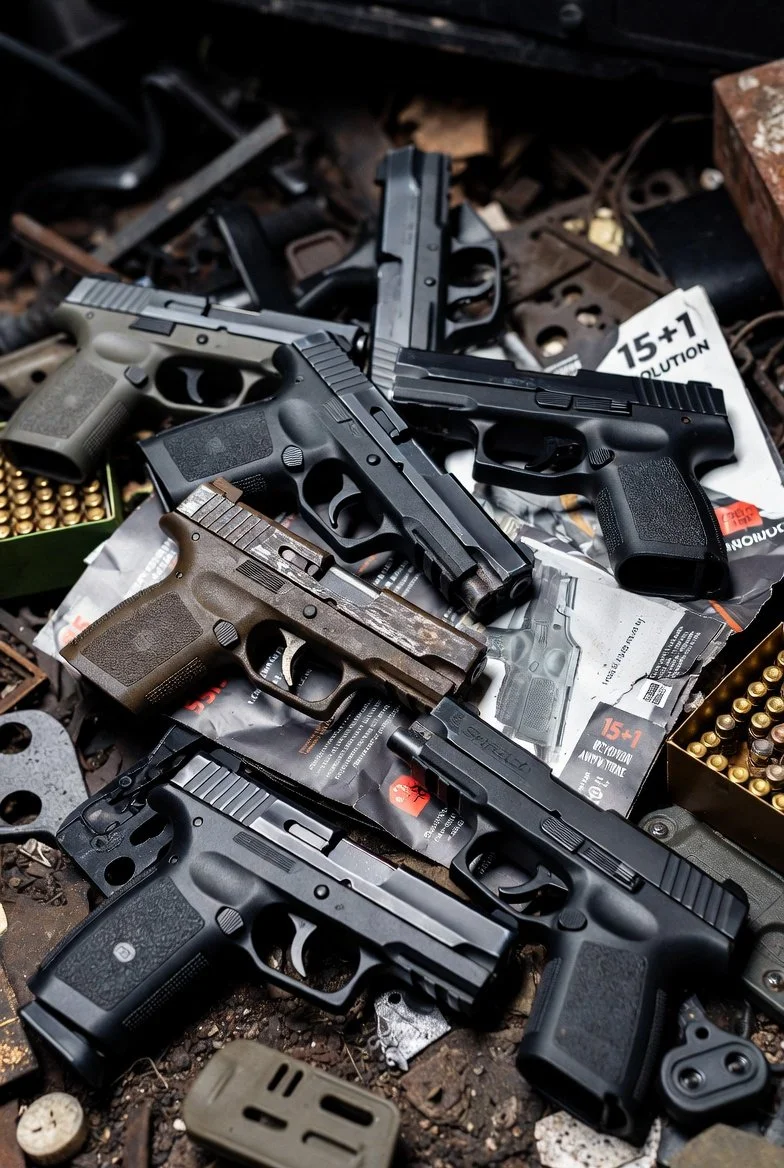
If you read Part 1 and Part 2, you already know I walked away from double-stack micro-9s after real testing and real training. You know women are quietly doing the same thing. Now we get to the cold, hard core of it: the entire concept is built on hype that solves nothing real. It chases problems that don’t exist, piles on features before the basics are even fixed, and even the “best” version on the market still falls short. Here’s exactly why the double-stack micro-9 is a dead end — even if manufacturers keep throwing money and engineering at it.
PHYSICS DOESN’T LIE
Lighter gun equals more recoil. Full stop. Every action has an equal and opposite reaction. You cannot cheat Newton.
Single-stacks like the Walther PPS and Beretta APX A1 Carry were never ashamed of their weight. Heavy slides, thick chassis, strong recoil springs — they absorb the slam and spread it out. The APX A1 Carry laughs at Winchester 115-grain service-grade ammo (hotter than +P, closer to +P+). The PPS, built for a police contract, does the same. European designs were engineered to NATO standards; they hold up.
Double-stack micros strip every ounce to stay “concealable.” Thin polymer walls, short grips, light slides. Vibration has nowhere to go, so it slams straight back into your hand. That’s why the Shield Plus punished me after thousands of rounds. That’s why the CSX — smaller and lighter than the Shield Plus — kicked even harder, had a feather-light recoil spring, and beat the slide into the frame. Women love the crisp trigger and light spring at first… until the recoil starts biting. Then they hate it.
Add in the shorter barrel and you lose velocity and sight radius. The gun becomes harder to shoot precisely past 10-15 yards. Red dots are supposed to fix that — but they just make the gun taller, print worse, and don’t solve trigger slap or grip fatigue. You cannot out-physics physics. The hand feels it every single time.
THE UPGRADE TRAP
So what do people do when the base gun sucks? They “upgrade” it. Air quotes intended.
Weapon-mounted light? You’re now pointing a loaded gun at someone just to identify them — brandishing at best, assault with a deadly weapon at worst. Cops get away with muzzle sweeping because of qualified immunity rooted in Terry v. Ohio (1968). You don’t. And it kills concealability anyway — adds half an inch to the muzzle, bulks the holster, prints like a brick. Real low-light work is done with a handheld flashlight and one-handed shooting. The “tactical transition” fantasy is just that — a fantasy.
Red dot? Fixes the short sight radius by making the gun taller. Same problem.
Extended mags + spare? That’s not preparedness; that’s paranoia. If you need 15+1 plus a spare to feel safe, why not just carry the duty gun?
Every single “upgrade” screams “this gun sucks on its own.” And every upgrade makes it harder to carry, harder to draw, harder to hide. The CSX even tried to be honest with backstrap extensions for a full-size grip — smart — but still added an optics cut and ambi safety that my trigger finger blocked on such a tiny gun. It was trying to be a micro 1911 and failed at both.
INVENTED PROBLEMS, REAL CASH
The gun industry doesn’t wait for real needs — it creates them.
“You need more ammo!” → cram 15+1 into a pocket. “You need a flat trigger!” → box it in so you stop buying aftermarket. “You need optics and lights!” → add cuts and rails before anyone asked.
Single-stacks grew from actual demand. Kahr CM9/PM9 in the ’90s were cop backup guns. Walther PPS was literally named for police. M&P Shield started as a duty-minded option. We perfected them over 20 years — shootability up, price down, recoil tamed. We hit the apex. Then greed took over.
Double-stack micros? No military asking. No police departments calling for them. No off-duty cops carrying them as backups. Just civilian marketing: “Hollywood capacity in your pocket!” So they invent the problem, sell the fix, and keep selling upgrades. Tariffs hit copper (50%), steel, lead, primers, powder. Costs rise. Manufacturers cut corners — thinner metal, weaker springs — to keep guns “affordable.” Or they make them heavier to handle the heat. Either way, you pay.
HK CC9: THE HONEST END — BUT STILL NOT WORTH IT
If any double-stack micro-9 deserves respect, it’s the HK CC9. HK finally did it right. Slim grip, light rail, optics-ready (some versions even come with dots), backstraps for perfect fit, flat-ish VP9-style trigger, ambi controls, flush and extended mags. Durable. Reliable. Shootable — as good as physics allows a light gun to be. They didn’t cheap out. They built exactly what the market screamed for.
And people still complain: “Too expensive!” “Came late!” “Trigger needs to be lighter!” “More capacity!” The craze never ends. Even when you give them the premium version — honest price, honest engineering — it’s still light as hell, still kicks like a mule, still snappy under stress. It does everything the market asked for… and it’s still not enough.
That’s the proof the journey was never about need. It was about “more.” More rounds, more features, more “tactical.” The CC9 is the ceiling. And even at the ceiling, it’s still a compromise I don’t want.
REAL-WORLD PROOF: CAPACITY ISN’T KING
Look at actual shootings.
Eli Dicken at Greenwood Park Mall — engaged at 40 yards, missed his first two shots, closed to 25 yards and still wasn’t making clean hits. He finally dropped the threat closer in. That wasn’t a capacity problem. That was a training problem. A Glock 19, M&P Shield, or Walther PPS would have done the same job if he’d trained better. He didn’t need 15+1. He needed hits.
Kyle Rittenhouse fired only eight rounds total in the entire incident — rifle, not pistol. He would have been fine with a six-plus-one 9mm. No reload. No bolt lock.
Most civilian self-defense shootings end in under eight rounds — even with multiple attackers. If you need 12+ rounds to stop one person, the situation probably wasn’t defensive to begin with. Plain-clothes undercover officers might need duty capacity because they have a badge and an obligation to finish the fight. Civilians don’t. Even many of those officers still choose single-stacks for concealability and shootability.
WHY SINGLE-STACK STILL WINS
After everything — the physics, the upgrades, the hype, the “best” version — I still carry single-stacks. Not because they’re retro. Because they work. The Beretta APX A1 Carry? Two hundred bucks. Shoots like a full-size, eats hot ammo, no wear. Optics cut exists — I ignore it. Iron sights only. The Walther PPS? Three hundred now — still in production, still backed by Walther, no recalls. Cheap not because it’s junk, but because everyone chased the new hotness and forgot the proven.
These guns were perfected when single-stacks were the real need. They’re budget kings: durable, reliable, shootable. No beta testing. No feature creep. You buy one, train it, carry it — done. Double-stack micros? Four hundred bucks plus holster, red dot optic, weapon light — 800 hundred easy. Lightweight means recoil bites, slower and harder to shoot well, breaks sooner after serious usage due to cutting corners for weight and cost, prints even though it is sold as being just as good as a single stack. Single-stack? $300 out the door. Shoots better due to higher density, lasts longer due to better made materials and parts, conceals easier. No compromise.
If you’re not a cop, not running ops, not prepping for the end times — why pay more for less? The math doesn’t lie. Proven guns at budget prices beat invented hype every single time. The double-stack micro-9 was never a revolution. It was a marketing trap dressed up as progress. And even the best version on the market proves it.
That’s the end of the series. If you want the guns that actually work — the APX A1 Carry or my full-size 1911 in a Clinger Hinge — they’re waiting for you. Stop chasing “more.” Start carrying what wins.