SHOOTING TO LIVE: THE PRACTICAL TRAINING PROGRAM OF WW2
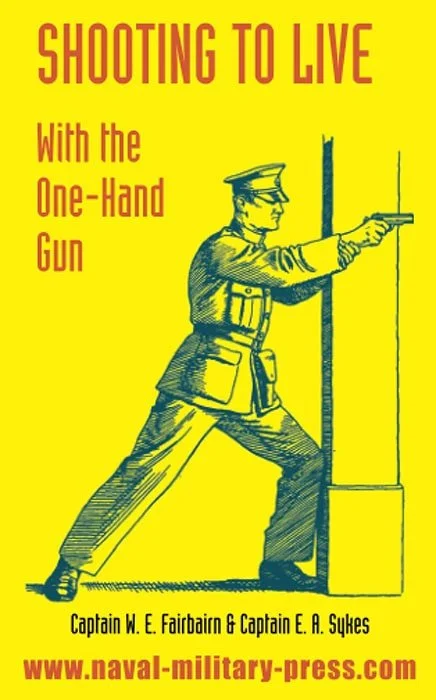
In WW2, W.E. Fairbairn taught close quarters pistol fighting to the special units of the Allies and recorded his teaching method in the book ‘Shooting to Live’. He developed his pistol lessons by evaluating and honing the instincts of the police officer that is obligated to confront criminals in dark allies. He spent years training police how to survive a gunfight by being faster, using their instincts, and training under fighting conditions as often as possible. After reading this book, it is hard to feel like we have a more advanced understanding of pistolcraft today.
MISCONCEPTION OF INTENT
This manual was not written to be a counter-argument to the concept of sighted fire. Police officers of the time did recieve training in using their firearms, just as they do today. However, much of the teaching was on sighted fire on a static range for score. This is unfortunately still how it is done today, but with manipulations and a cute sidestep here and there under a timer.
The author is clear that target shooters designed the courses of fire and have this idea that their empire is the best to follow. He points out that he commends target shooters for their abilities, but that they are not immersed in the struggles of the Police officer and military man entrusted to approach and take on criminals and enemies of the state. The author makes it clear that the methods in the book were not supposed to take the place of sighted fire, but rather it answered something sighted fire failed to teach.
STILL USED TODAY
This is the first manual that discussed the brutal reality of gunfights at close range, and unfortunately the techniques are still valid. Today, you can still access and train the way the greatest generation of special operations trained. In many ways, this is the type of shooting employed by the Israeli military in their instinctive shooting courses. I have taken their close quarters pistol shooting course, and it still relies on instinctive shooting, as much of ‘Shooting to Live’ teaches. The Israeli shooting method is taught with 80% dry fire and 20% live fire, much like what is preached in the manual for ‘Shooting to Live’. It is quite obvious that much of the Israeli Instinctive Shooting method has its roots in the Fairbairn method
BASED ON STUDIES OF ARMED CONFLICTS
As with modern police shootings, Fairbairn did a fair amount of studying to see what was happening when police officers were getting into shootings. What he found is that the officers were often caught by surprise or only had a moment to outdraw the criminal. Most of the shooting happened within 4 yards and often after the officer had already given chase and are already mildly fatigued. This gave officers little time or coordination to be able to put well aimed shots on their threats. Often this led to them being shot or missing horribly.
Not much has changed in Law enforcement gun fights except that the average distance, according to the FBI, is 7 yards. I think a lot of that change in average distance is due to more standoff shooting, patrol officers using greater distances when approaching subjects, treating suspects as possibly armed, etc. However, officers still have a terribly low hit ratio of 20-30% in shootings, and this is with sighted fire at close range. Often this is the resulty of an incomplete sight picture and the urgency of the situation making the officer squeeze off panic shots. In many instances, instinctive shooting would not only be faster, but perhaps more accurate.
The average civilian self defense shooting, outside and active killer/shooter, is still a very close quarters affair. Unlike officers, a civilian is not going to be able to draw their firearm without just cause. This means that we need to be faster and may have to rely more on instinctive shooting up close rather than obsessing with sighted fire. This is where the manual comes in.
AMMO CONSERVATION IN TRAINING
This manual consistently stresses the importance to conserve ammunition through dry fire practice and intentional range practice with minimal ammunition usage. To put this into context, the relative cost of a 50rd box of .45 ACP ammunition was $125 if we account for inflation and the average income of workers at the time. These days, ammunition in general is exceptionally less expensive today. Imagine if ammunition still cost that much outside of a gun scare or ‘Plan’demic.
A 1911 in those days were way more prohibitive for the average consumer due to the relative low wages and income of the day. If we were to do the same math as we did for ammunition, we will find that the 1911 of the era would cost roughly as much as a MK23 today ($2000-$2600). This time frame was around the time of the depression recovery when wages were rising somewhat and the country was starting to get back on it’s feet.
WILL THIS PUT YOU IN LEGAL JEOPARDY?
Much of what is taught in ‘Shooting to Live’ is based on point shooting or instinctive shooting. The idea is that you are so close that neither time nor distance afford you the opportunity to use sighted firing techniques without putting yourself in mortal danger due to time wasted. However, in todays litigious society where those that are victims are treated as criminals, all actions are subject to courtroom scrutiny. Much depends on the circumstances surrounding the event, also known as the ‘totality of circumstance’.
The manual points out that the idea is not to condemn sighted fire, but to add an option to officers that are ONLY taught to use sighted fire. This was written to answer an issue the officers actively dealt with on the street; armed criminals they must engage at extreme close quarters. It is not saying that the shooter doesn’t need to get rounds on target, but it points out that officers need to be faster than the criminal that is already acting against them.
The responsibility to make hits on target is the same for the officer as it is for the civilian defender. Based on the findings of the manual and the realities of gunfights today, I would say that unsighted fire is superior to sighted fire in matters of close quarters fighting. In short, the principles taught by this book are still valid and still relevant. In many shootings, officers and civilians rely on point shooting due to an urgency for speed. Though any missed shots can find you liable, the instinct to survive precludes sighted fire at extremely close range where full presentations are not suitable or needed for effective target engagement.
PISTOL RECOMMENDATION
In the book, the author talks extensively about how the use of an automatic pistol is faster to learn and how it’s reliability is greater than a revolver. His insights to the rugged nature of the auto-loading pistol, even in the 30’s sounds almost contrary to the old timer claims of today that hold the revolver into almost impervious territory. His insight to pistols of the day (1930-1940’s) are still true today, particularly talking about shootability and reliability as it relates to size and caliber. He also points out the fact that most of the accidents and mishaps with firearms happen when too many safeties are applied to the firearm. However, his recommendations for modifying the firearm safeties is something that may not be the best idea to follow.
I particularly liked how the author answers the individuals who ask what gun they should own. He mentions that owning a gun and training with it to be efficient and good with it are to go together. He mentions that most who ask what gun to get are not gun owners and often will not commit to habitual training and practice. If a person wants to own a gun, they should seek training first and then make a decision on their own based on good experience.
TECHNIQUES USED
The chapter on technique practicing is labelled as being designed for recruits and those uninitiated in safe gun handling practices. It starts by talking about taking one hour practicing safe loading and unloading and minding the muzzle with care. This is very familiar to any person trained today, except it omits trigger finger discipline.
After this hour of training and practice, the author discusses the first live fire drill that the shooter will practice under the watchful eye of an instructor. It articulates what kind of target to use, what distance the student should be from the target, and why. It is a well written section that is simple, but still seems like a clean way of taking a beginner through a course of fire. There is no stressing about stance or body positioning yet. Just a drill on getting the gun in your line of sight from the ‘ready position’ and point at what you are looking at and pull the trigger.
The basic drills provided in the book are based on having the shooter shoot at full extension with one hand, as if under immediate duress. Each shot string is to be coached and corrected, but not too much ammunition is to be used in doing this. Again, ammunition of the era was extremely costly and the equivalent of the cost of .50AE/.50BMG.
The techniques presented in this book are specifically designed for when time and distance preclude the ability to apply sighted fire, such as gun fights well within 10 yards. The author is clear that sights are nice to use if able, and should be practiced at range. But up close gun fight training is a waste and assumes you will be given the time and the opportunity to square up and shoot a perfect shot. Real life officer and civilian shootings often show that fights well within 7 yards are so close that sights are not only wasteful, but place the user in mortal jeopardy.
PRACTICAL SHOOTING COURSES
As you read through this section of the book, you will notice that the author is making it for training the recruit of the military, Law Enforcement, or the ignorant and untrained civilian. However, the basic premise of the training would still be considered very good and information rich, even today. As I have mentioned before, modern firearms practitioners are not much more advanced to this day. I would go as far as to say they are less imaginative, less realistic, and more obsessed with sighted fire from a static context.
The practical course suggested in this book mirrors the description of the '“HOUSE OF HORRORS” that OSS/SOE recruits went through. The course is live fire, done indoors without hearing protection. The aim is to navigate the poorly lit house full of obstacles and bystanders (straw and stuffed mannequins) while being ready to draw and fire your gun at any moment. A controller will set off a blank round from a control station and set off targets that appear and disappear so fast that aimed fire is worthless. The idea is to get you to use your newly learned instinctive shooting techniques.
I appreciate the fact that the author talks also about the fact that you need exposure to shooting indoors more often to be exposed to low light and sound appreciation when shooting indoors. Also he stresses the importance of good ventilation and the effects of having a lot of particulates irritating the eyes if you linger too long. This is something people who shoot suppressed ARs encounter if they do a particularly rapid string of fire.
LAST PAGES
The last couple of chapters are on stopping power theory and it goes into some pretty interesting ideas about how someone may be incapacitated. In general, the author is hesitant to apply a rule to what caliber is recommended and does a good job of showing that a near miss on the torso is still a miss and officers often had to go hands-on with the subject to stop them. This is a valuable articulation that is still true today, and is unfortunately found on body camera footage in close range shootings.
There is a basic chapter on cleaning the pistol and maintaining it, which is very old and telling about the lack of quality in gun cleaning and lubrication technology of the era. At that period, the soldiers in the Chinese Army were using animal fat as a sort of grease, and I am tempted to say that would have worked better than the oils of the day.
SUMMARY
In general, this book is a great read for both historical and technical information. It is sad that we have lost a lot of this art of shooting and the understanding that close quarters shooting is best resolved with instinctive shooting at speed rather than sniper-style shooting. I very much appreciate the knowledge in this manual, and I have put it to practice for myself.