MILITARY FIREARMS TRAINING IS A JOKE, AT BEST
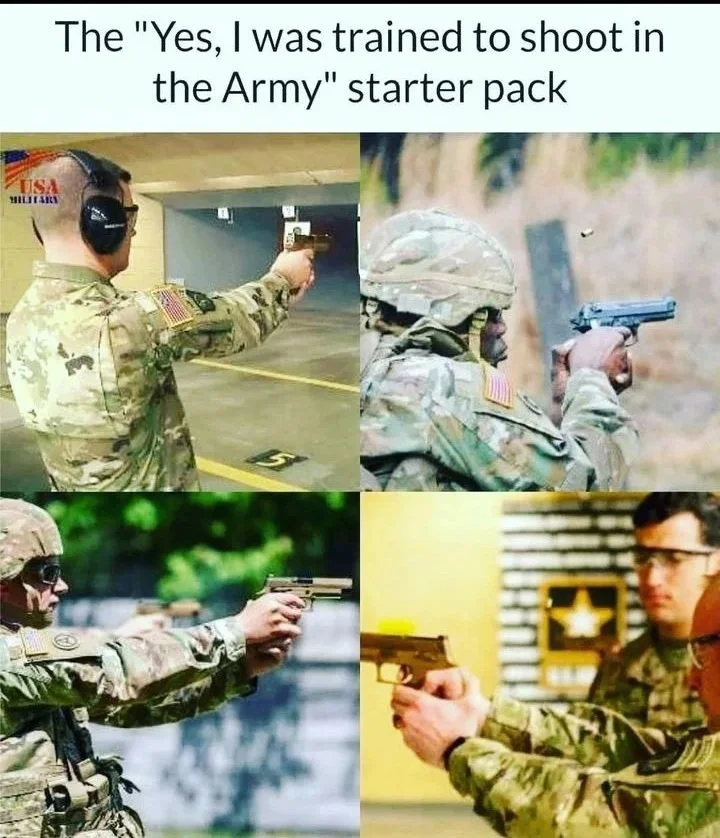
All too often I have heard people talk up individuals they know who were in the military as being an option for teaching them how to shoot. This makes me laugh, because I saw some of the worst shooting and worst training in the military, all because of institutional inbreeding and failure to adapt. (My experience is strictly USMC—I never served in the Army or any other branch.) When I personally got out of the military, I found that what I was taught in the Marines was not only basic, but it was darn near insulting. If you paid for that kind of training, you would feel ripped off.
BOOT CAMP: CEREMONY OVER COMBAT
In boot camp, or basic training, we were taught how to walk with the rifle on a drill field where our movements and handling of the rifle was 99% ceremonial. This was based on tradition and had 0% practicality. The only time we handled the weapon in a martial sense was when we were doing bayonet training in first phase, or practicing marksmanship and patrolling in second phase.
The military still teaches shooting from the mindset of drill and parades instead of warfighting. They will teach shooting on a flat range in ideal positions and try to develop your confidence by teaching you sport shooting at static targets at designated ranges. Any shooting that is done at night or at close quarters is still just paper silhouettes on a flat range and outside of the static distance shooting, performance isn’t scored, or even coached well. It is mass training.
All of this ceremonial drill is sold to us as “just instituting discipline” — the magic ingredient that supposedly turns civilians into unbreakable warriors who obey without question. I understand that this style of training is steeped in tradition, but when war changes, I think it is on the military to change to accommodate it, not practice who can be more stubborn. Tradition is great for uniforms and standards like reveille and Colors, but when training to use your weapons of war is treated like a ceremonial check in the box, I have a huge issue with that.
THE DISCIPLINE MYTH: BLIND OBEDIENCE THAT KILLS MORE THAN IT SAVES
Here’s the part that really pisses me off and should make every leader in the Corps and the Army hang their head in shame: the entire justification for all that parade-deck nonsense is “discipline.” Absolute, unquestioning, follow-orders-to-the-letter discipline. They drill it into you from day one — snap to attention, move exactly like the guy next to you, never question, never improvise. And they swear up and down that this is what wins wars.
It’s a lie. And it’s a deadly lie.
Absolute discipline — blind obedience to orders every single time — has caused more American casualties and lost more conflicts than almost anything else in modern warfare. Vietnam? Rigid search-and-destroy tactics from the top down while the enemy adapted on the fly. Afghanistan? Twenty years of top-down ROE and conventional thinking while the Taliban used initiative, local knowledge, and decentralized decision-making to bleed us dry. Time and again, the conventional force that demands robots who only follow the plan gets smashed by enemies who reward thinking on their feet.
The Marine Corps loves to brag about the Crucible — that famous 54-hour gut-check at the end of boot camp that’s supposed to be the ultimate test of leadership and initiative. Recruits are told it’s where you learn to lead, to make decisions under exhaustion, to rely on your team and think for yourself. It’s marketed as the moment you stop being a recruit and start becoming a leader of Marines.
In practice? Complete bullshit.
The second you hit the fleet, initiative is punished. Free thinking gets you screamed at or written up. “That’s not how we do it here” is the unofficial motto. Suggest a better way to clear a room, move under fire, or adapt to the enemy in front of you? Good luck. The system is still built for draftees who needed their hands held and their brains switched off. Volunteers who are smart enough to score high on the ASVAB and fit enough to make it through are treated like they can’t be trusted to think.
Special units prove the point every single day. MARSOC Raiders, Delta, SEALs — their entire training and mission sets are built on the opposite philosophy. Every operator has a voice. Tactics, techniques, and procedures (TTPs) are developed from the bottom up. Junior guys on the ground feed real-time intel and adjustments straight into the plan because mission command (the modern version of “commander’s intent”) demands it. They succeed where conventional units fail precisely because they reward initiative instead of crushing it.
The old-school discipline model isn’t tradition — it’s the reason we keep losing the wars that actually matter. Until the Corps and the Army stop punishing the very leadership qualities they claim to build in the Crucible, they’re just manufacturing obedient targets instead of warriors.
SUSTAINMENT TRAINING: THE ANNUAL RIFLE QUALIFICATION FARCE
Boot camp is just the start. Once you're in the fleet, the real insult kicks in: the Annual Rifle Qualification (ARQ). Until the 2021 overhaul, it was the same century-old static course. The "new" ARQ finally added combat gear, barricades, moving targets at 200/300 yards, time pressure, and shooting from 500 yards down to 15 yards on realistic "bad guy" targets that only count vital hits (heart/lung/brain). Sounds better, right?
Here's the catch: this more realistic version is still not fully implemented at boot camp or for most non-infantry Marines. Recruits still start with the legacy static qual. Full ARQ rollout for entry-level training isn't mandated until late 2028, with complete fleet conversion by FY2029. Non-infantry Marines—cooks, clerks, mechanics—get maybe 300–500 rounds a year, one qual day, and zero advanced coaching. Infantry gets slightly more, but unit tempo, range availability, and "check-the-box" mentality mean most quals are still rushed paper-punching sessions. Recent 2024 policy changes now force pre-qual scores to be Expert only or you shoot the full course—no more ducking out with a Marksman badge—but that just pressures the system without fixing the underlying lack of volume or realism.
Result? Pass rates hover around 69% qualified on the new ARQ in early tests (9% Expert, 21% Sharpshooter, 38% Marksman, 31% unqualified in one 2021 pilot). Army data shows even worse: a 2019 evaluation found only 7.6% of tested soldiers could hit 80% on basic marksmanship fundamentals. In the Global War on Terror, the U.S. military burned roughly 250,000 rounds per enemy killed. That's not elite marksmanship—that's spray-and-pray enabled by endless ammo budgets.
THE ARMY SIDE: EVEN WORSE MASS-PRODUCED MEDIOCRITY
The Army doesn't even pretend to have the Marines' "Every Marine a Rifleman" mantra. Their Basic Combat Training rifle marksmanship is three weeks of Preliminary Marksmanship Instruction (dry-fire positions, barricades, manipulations) followed by live-fire tables on static pop-up targets out to 300 meters. The new qualification under TC 3-20.40 (fully rolled out by 2025–2026) has six tables, position changes, magazine swaps, and time pressure—but it's still known-distance, paper or pop-up silhouettes, no real movement under fire, minimal night or stress work for most soldiers. Annual quals for non-infantry? A few hundred rounds a year, one day on the range, and you're done until next year. Pass rates hover around 70–80% qualified, with Experts often under 20%. The Army's own internal data shows the average soldier still sprays hundreds of thousands of rounds per enemy killed in real fights. Same story as the Corps, but without the rifleman culture—pure check-the-box for a force that's been all-volunteer since 1973.
CIVILIAN TRAINING THAT ACTUALLY BUILDS WARRIORS
Now contrast that with what two private outfits deliver to total beginners in a fraction of the time.
Max Velocity Tactical (MVT) HEAT 1 Combat Tactics—a straight 4-day live-fire course—takes a civilian with zero experience and builds a functional basic light infantryman. Days 1–2: flat range hammering fundamentals, zeroing, instinctive manipulations, malfunction clearances, cover use, scanning, target discrimination, and rates of fire. Then Days 3–4: full team tactics—react-to-contact drills, break-contact maneuvers, live-fire assaults, and patrols. Students burn 800–1,000+ rounds, work in fire teams, and leave able to fight as a unit under stress. No ceremony. No waiting for the slowest guy. Just combat-proven TTPs from real light infantry experience.
One Shepherd Leadership Institute does the same with immersive, force-on-force simulations. Their Warrior Basic Course (2 days) starts with shoot/move/communicate fundamentals. Then their STX seminars and FTX battle simulations (multi-day semesters) throw you into squad- and platoon-level patrolling, ambushes, raids, and leadership under realistic pressure. You command teams, make decisions in the chaos, and learn through repeated experiential wargaming. Civilians walk out with practical small-unit tactics and leadership that most career soldiers never touch.
Four days at MVT or a One Shepherd semester turns a blank-slate civilian into someone who can actually move, shoot, and lead under fire. A four-year (or twenty-year) military career? Static quals, ceremonial drill, and the occasional rushed range day.
THE COST COMPARISON: TAXPAYER DOLLARS WASTED VS. PRIVATE EFFICIENCY — AND THE INSULTING LIE WE'RE ALL SUPPOSED TO SWALLOW
The military loves to brag about the “huge investment” it makes to “produce a basic warrior.” According to DoD budget data and independent analyses of the full initial entry pipeline, it costs the taxpayer between $60,000 and $100,000 per recruit to push someone through boot camp plus infantry school (USMC School of Infantry or Army OSUT). That number supposedly includes recruit pay and allowances during training, instructor salaries, facilities maintenance, range operations, ammunition, medical support, and all the bureaucratic overhead. For Marines, that’s now 14 weeks at Infantry Training Battalion on top of 13 weeks of boot camp. For the Army, it’s 22 weeks of One Station Unit Training. All that money, all that time — and we still end up with the mediocre, ceremonial garbage I described earlier.
Here’s what actually makes me furious and what should insult every veteran and taxpayer who hears it: people actually buy into this bloated number like it’s some sacred truth. It’s insulting as hell. It treats us like we’re too stupid to know what really happens inside those infantry schools. The whole thing is glorified summer camp with weapons. The ammunition was bought and paid for years ago, the ranges and facilities are already built and maintained on the taxpayer dime forever, and the “training” is just mass-processed, slow-motion repetition for an audience that doesn’t even exist anymore. If you stripped away the ceremony, the parade-deck nonsense, and the endless waiting around, and you tried to replicate exactly what they do today as a private citizen — rent some land, buy some targets, and run the same drills — it would cost about the same as just signing up for Max Velocity Tactical or One Shepherd and finding yourself a cheap hotel for a few nights.
Max Velocity Tactical HEAT 1 (4 days): $950 tuition. Add your own 1,000 rounds of ammo (roughly $400–$500 at today’s prices) and you’re under $1,500 total out of pocket. You leave a functional light infantryman.
One Shepherd Leadership Institute Warrior Basic Course entry + initial semesters: as low as $300 for the 2-day Warrior Basic, with full immersive start-up training under $1,000 total. Same or better results.
That’s it. Less than 2% of what the military claims to spend — and the private side delivers faster, harder, and far more realistic training with zero tradition-worship and zero draftee-era hand-holding. The taxpayer is getting absolutely fleeced while volunteers who actually want to learn are short-changed.
THE EMOTIONAL TRUTH THAT SHOULD MAKE EVERY LEADER FURIOUS
This is what boils my blood: we have the best volunteer force in history—smart, physically fit, highly motivated men and women who chose to serve. ASVAB scores are higher, fitness standards are tougher, and retention is built on commitment, not conscription. Yet the entire training doctrine is still built for draftees from the 1940s–1970s era—low-aptitude, unmotivated kids who needed everything dumbed down, slowed down, and repeated a thousand times in mass formations. Institutional inbreeding keeps cranking out the same parade-deck, check-the-box garbage because "that's how we've always done it."
It makes me furious. We could have a truly cutting-edge military tomorrow if leadership had the balls to scrap the old model and just hire Max Velocity Tactical and One Shepherd Leadership Institute to redesign and deliver the shooting and tactics programs. Four days with MVT or a semester with One Shepherd produces better riflemen and leaders than the military does in years—because they treat students like capable adults who can learn fast, move fast, and fight smart. No more treating volunteers like drooling, flighty pacifists who can't handle real training without endless hand-holding and ceremonial fluff.
The military wants to brag about being the world's most professional force? Then stop using doctrine written for retarded draftees in a conscript army that no longer exists. Stop the inbreeding. Stop the stubborn tradition worship. Hire the experts who actually know how to build warriors in days, not decades. Until then, every "veteran instructor" recommendation is a joke, and every taxpayer dollar spent on range time is wasted on mediocrity.
WHY THIS MATTERS—AND WHY THE MILITARY MUST CHANGE
Wars aren't fought on parade decks. Modern threats—urban CQB, drones, night fighting, peer adversaries—demand shooters who can move, think, and hit under real stress. Treating weapons training like a ceremonial checkbox in a volunteer military isn't tradition; it's negligence. The Corps and the Army are finally inching forward with ARQ and TC 3-20.40 updates, but the pace is glacial and the foundation is still rotten. If you're a veteran recommending military buddies as shooting instructors, be honest. Most of us weren't taught to fight with a rifle—we were taught to look good carrying one.