MOSSBERG 590A1 OPERATORS MANUAL
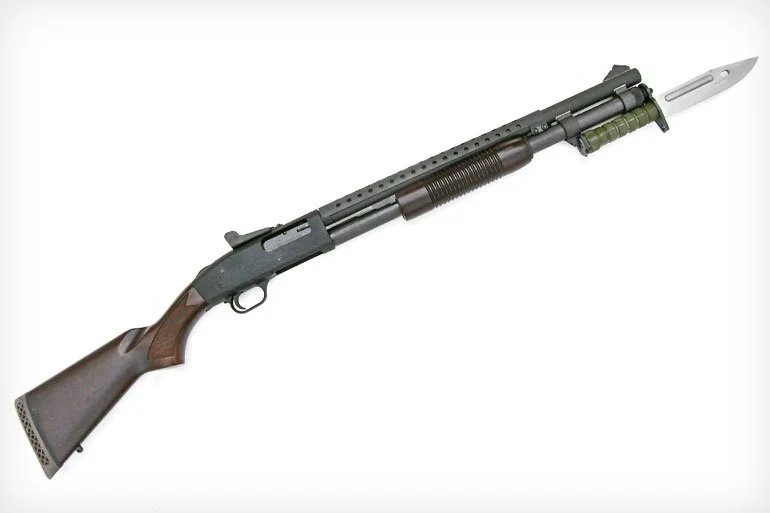
The Mossberg 590A1 is a 12-gauge pump-action shotgun that evolved directly from the Mossberg 500 series (introduced in 1961 by designer Carl Benson as an affordable, reliable hunting/law-enforcement firearm with an aluminum receiver, ambidextrous tang safety, dual action bars added in 1970, and over 11 million units sold).
In 1987, Mossberg created the Model 590 specifically for U.S. military trials by upgrading the 500: metal trigger guard and safety (replacing polymer), a “clean-out” magazine cap for field stripping without tools, 20-inch barrel, Parkerized finish, and 6-round extended tube. It became the only pump shotgun to fully pass the rigorous U.S. Army MIL-SPEC 3443E protocol (drops, environmental extremes, and 3,000+ rounds of full-power buckshot with full parts interchangeability).
The 590A1 variant followed shortly afterward (late 1980s/early 1990s) at the request of the Navy and other branches: it added a heavier, thicker-walled barrel (to survive impacts and sustained fire), optional barrel shroud, bayonet lug, and up to 8+1 capacity. It entered widespread service across U.S. Army, Marine Corps, Navy, and other branches as the standardized military pump shotgun.
It saw heavy combat use in Iraq and Afghanistan (especially urban CQB by Marines in places like Fallujah) and remains in active U.S. inventory today. As recently as December 2025, the Army awarded Mossberg an $11.6 million contract for more 590A1s—now explicitly including counter-drone (anti-UAS) roles.
AS A MILITARY WEAPON SYSTEM
The 590A1 is purpose-built for reliability in harsh conditions where semi-autos can fail (sand, mud, extreme cold). Key military roles include:
Close-quarters battle (CQB): 00 buckshot delivers devastating one-shot stops inside 25–50 yards.
Door breaching: Specialized frangible or slug loads blow locks/hinges (pump-action cycles any load, even underpowered ones that jam semi-autos).
Less-lethal/riot control: Beanbag, rubber ball, or rubber slug rounds.
Counter-drone: Birdshot or specialized loads (current procurement focus).
Utility: Bayonet mount, ghost-ring or bead sights, and the ability to fire any 12-gauge ammunition (slugs for longer range/penetration, flechettes, beanbags, etc.).
Its manual action, metal internals, and MIL-SPEC durability make it the military’s go-to pump when absolute reliability and ammo flexibility trump semi-auto speed. It was the primary U.S. military shotgun until the Benelli M4 semi-auto supplemented it in the early 2000s, yet the 590A1 persists because it never fails when dirty and costs far less to field.
AS A PRIMARY ARM FOR A GUERRILLA
In partisan or resistance scenarios (urban fighting, ambushes, or areas where conventional rifles are scarce), the 590A1 excels as a primary or “go-to” weapon for the same reasons militaries love it:
Simplicity and reliability: No gas system to foul; works after being dragged through mud, buried, or poorly maintained.
Ammo ubiquity: 12-gauge shells are among the most common civilian rounds worldwide—easy to scavenge, reload, or source locally.
Devastating close-range power: Buckshot clears rooms or stops vehicles at ambush distances; slugs punch through cover.
Versatility: One gun handles personnel, breaching, signaling, less-lethal intimidation, or even anti-drone defense.
Real-world analogs exist in police/military auxiliary roles and historical irregular conflicts where shotguns filled gaps left by limited rifle supplies. However, honest limitations exist: effective range is short (buckshot drops off sharply past 50–75 yards), capacity is lower than modern rifles, and reloads are slower. It is not a long-range or suppressive-fire weapon—best paired with rifles in a team or used in confined/urban terrain where its strengths dominate.
BREAK-IN RECOMMENDATIONS
- The last thing you should do is take this or any weapon system right out of the box and fire it.
- The 590A1 right out of the box is stiff and will need to be lubricated generously at first.
o Use Slip 2000 to thoroughly coat all metal surfaces of the weapon.
o The first wipe down will produce a brown coat of gunk that is normal for parkerized finishes
- If 590A1 model has a bayonet lug, practice attaching and removing bayonet to wear metal locking lug and make attachment more seamless.
LOADING OPTIONS
Shotguns are fantastically versatile due to their ability to be loaded to fit a variety of missions and needs. In modern warfare, many people have the idea that a rifle is optimal, despite the use of the rifle’s distance capability being replaced and supplemented with kamikaze drones, artillery, air power, and other indirect means of death and destruction. Rifle fire is still used as a means to close with and destroy the enemy, but I would wager that in an urban setting, the shotgun breaks even with the rifle.
Despite the generally low capacity of a shotgun and the difficulty it can present to someone trying to keep it fed, the devastating wounds it inflicts on people cannot be denied. There are as many loadings and payload options for the shotgun as there are styles of hair. It is nearly nauseating. I will just be mentioning my top three favorite loadings
00 Buckshot is the classic fighting load used by virtually everyone who has ever wanted to kill their target. This loading can be taken out to 75 or 100 meters while retaining its capacity to kill. This loading has the power to blast through an entire house, under the right conditions. In some extreme cases, the shotgun can be used to clear rooms without even entering.
One of my favorite loadings for the 12- gauge shotgun is the rifled slug. This 1-ounce hunk of hollowed out lead is the modern version of the Minie ball that absolutely wrecked dudes in the civil war. The 12-gauge slug is larger, but also faster and heavier. It will not be able to travel as far as the Minie ball, but it’s capacity to devastate the human form is greater, in my opinion. I don’t know of many accounts of people surviving a shot to the chest from a .72 caliber slug. Slugs are great for precision shots out to range, and penetration of barriers like bricks, steel, and other light barriers.
The last loading I want to mention is an example of what I think would be optimal for anti-drone work. The military is using tungsten pellets to give a harder hit over plain steel, but I think steel shot will work just fine, particularly out of an 18 or 20” barrel. A loading that seems to work really well for this job is the Fiocchi Field Dynamics HV 6SHOT 2.75". If this stuff can shoot a waterfowl out of the sky, I don’t see why a drone can’t be encouraged to cease its flight after taking hits from this loading. The spread is decent and I have this type of ammo on my Ammo Squared allocation, so it is always going to be a part of my stash for the foreseeable future.
ACCESSORIES AND GADGETS
- I highly advise against a stock or side saddle due to the added weight
o If ammo is to be attached to the weapon, side saddle that is aluminum is best
o Only use side saddle to store slugs. This allows for fast access and precision shots are going to be rare in a woodland environment where cover shooting is the primary tactic
- Be advised to consider a flashlight only as a means of searching a kill zone at night. The risk on an ND is too great
o Ensure light is sturdy and can survive at least 100 consecutive shots of buckshot before trusting.
- Replace the slide action handguard with the Magpul variant for better grip.
- If desired, use a red dot sight
o Due to parallax, zero the red dot out to 50m/yd and then work back to 25m/yd to check parallax
§ Put dot on the extreme left/right/top/bottom to check parallax
o Shotguns are hard on sighting systems; thus, it is recommended that you not rely on them
§ Test with 100 rounds of full power defense loads and or 3” shells to test tolerance for vibration and harmonics associated with rapid fire
- Enhancing the safety is an acceptable modification
o Ensure the finish is neutral
o Ensure the reassembly is tight and will hold up to firing conditions without disassembling itself
§ The safety on the Mossberg may be susceptible to extended firing and disassembly under recoil
INITIAL TRAINING TIPS
- Practice disassembly and inspection of the parts regularly.
o The small internal parts are not very easy to get together initially, and will require practice to learn to disassemble and reassemble with minimal effort
- Use snap caps religiously while practicing manipulating the slide action.
- Practice manipulating the safety off before shooting and back on right after shooting.
o The safety will be stiff and will benefit from lubrication and heavy usage
o Gloves may bundle up against safety while trying to flick it, though PIG gloves seem to do well
o Practice different positions to test your ability to actuate the safety and slide action positively
- Practice bayonet attachment and usage techniques, and get accustomed to the weight/balance shift when bayonet attached
- Practice transitioning to a sidearm and shooting one handed. If you are able to manage a sling, practice two handed more often, but do not neglect one handed training.
- Practice emergency and top off reloads, as well as “shoot one, feed two” technique on the move.
o You should not have to look at the shotgun to reload.
- Develop a universal method that works when crouched, prone, moving, and indoors. My techniques are:
o Chicken wing the shotgun with muzzle up to load from left side pouches
o Pelvic index (right pelvis) with muzzle up, holding the slide action, ejection port up to load from right side
§ Alternative option is resting the stock on the right shoulder while moving, or when in the open
- Practice loading from different positions and from all pouches. Then practice reloading while moving and getting into position.
o Practice shooting one shot, racking, then loading two shells.
FAMILIARIZATION FIRE CONSIDERATIONS
- Pattern the 590A1 using slugs at 25, 50, and 100m/yd first.
o Confirm zero of sights and adjust as needed. Sights will only be adjusted to fit the POI of slugs out to 50m due to it being the average distance in woodlands.
§ Kentucky windage used for 100m/yd shots
o Check zero at 50m with bayonet attached
- Pattern the 590A1 with a variety of buckshot to analyze the spread
o Use 2 shots at each distance
o Analyze spread from 25, 50, and 100m/yd
o Check patterning with bayonet attached
- Practice emergency reloads from underhand and overhand using the “pinky/index” cupping technique
- Practice shooting chosen sidearm one handed as you would when holding shotgun
- Practice transitioning from buckshot to inserting a slug.
o Engage target at 25m and then transition to engaging a target at 50m with a slug
§ Rack slide action back just enough to eject shell but not far enough to kick out next shell onto loading ramp. Load slug through ejection port as you would an emergency reload
§ After last shot, insert slug into magazine and run slide action
COVER SHOOTING
In theory, the shotgun is optimal for cover shooting due to its ordnance options. You can shoot 2 ¾” or 3” shells, and this can affect range, payload (more pellets/higher hit probability), power/recoil, and capacity (6 vs 8). Each shotgun will pattern differently with different loadings, which will be important to know when cover shooting. Also, recoil and capacity is important when operating in close quarters. Depending on how the weapon patterns, you may find that 3” buckshot actually is worth the reduced capacity and the extra recoil due to the added pellets and extra power.
In cover shooting, it is all about the amount of ordnance you are sending downrange at possible cover. The higher the pellet count, the higher hit probability, to a point. If you decide to change the loading from 00 buck (equivalent to 8 or 9 0.36 pellets) to #4 buck (equivalent to 21 to 28 pellets of .24 caliber pellets) because you think more pellets means better coverage, you will significantly change the effectiveness of the shotgun. #4 buck has more pellets, but it also has smaller and lighter pellets that are more optimal for direct engagements instead of barrier penetration.
Cover shooting is all about leveraging sending multiple heavy pellets to hopefully hit a concealed enemy. By the time the loading gets to the enemy, it needs to still be capable of providing a solid terminal effect. Every loading is a compromise in some form and fashion, but historically, 00 buckshot tends to hit that nice middle ground of hit probability and terminal performance. Consider the fact that shooting 8 or 9 shells of 00 buck from a shotgun is the equivalent to 70-80 shots from a rifle. Simply direct the shots at suspected firing positions and concealed positions to pepper the area.
A point man or flanker are the most likely to get into a meeting engagement with the enemy. When this happens, shooting first is going to be vital to surviving. Shooting from the hip should be practiced at various ranges to facilitate getting your first shot off with greater accuracy. The remaining shots can be distributed to the left and right of the person you engaged. It is likely that the he is also a point man. However, it would be unwise to shoot in volumes and unload your magazine just to try and suppress the opponent. If you do not make hits, the enemy will notice and be harder to suppress later. Use only half of your magazine for the initial firing and cover shooting before seeking cover and feeding/replacing the shells you just spent.
ANTI-DRONE CONSIDERATIONS
Videos coming out of Ukraine show that soldiers are utilizing shotguns to great effect, when they happen to be used. The shotgun is great for this task for the same reason it is good for cover shooting. In these scenarios, #4 buckshot would be a good compromise for a patrol. More pellets that are still powerful can take down large drones with relative ease. However, even the shotgun is going to be a bit limited on how well it can protect you from the skies. A combination of marksmanship and payload selection will dictate your capability to protect yourself from drones.
CONCERNS OF RELIABILITY
Pump action shotguns like the Mossberg 590A1 are great for reliable functioning with a minimum amount of high wear components. However, modern semi-automatic shotguns are very reliable and fast. But they also come with a burden of having springs and gas regulators that can get gunked up. Now I know some will prefer an inertia system like the Benelli, but those are not good with reliability across a vast array of loads like something like the Beretta A300 or 1301. Also, the semi auto shotguns are going to be more sensitive to environmental factors when foreign debris gets in the action or causes binding in the inertia system.
CONCERNS OF DURABILITY
A pump action shotgun is still the king of durability. The closest to being as durable would be something like the Beretta 1301, which is equally indifferent to different ammunition types and has smooth functioning. However, unlike all semi auto shotguns, pump action shotguns have very few moving parts. Any parts that move, pivot, cant, slide, or rotate are due to your direct input through running the slide action.
The Mossberg 590A1 is built tougher than standard 500/590 models (heavier barrel, metal trigger guard/safety, thicker parts overall), so catastrophic failures are rare even after high round counts. However, like any pump shotgun, certain parts see accelerated wear from metal-on-metal contact, friction, cycling stress, and environmental factors. Here's a breakdown of the highest-wear or most commonly replaced items, based on user reports from forums (e.g., Reddit's r/Mossberg and r/Shotguns, AR15.com, Mossberg Owners), YouTube diagnostics, and Mossberg's own parts availability:
Top High-Wear / Problem Areas
Extractor(s) and Extractor Springs (both right and left side on the bolt face) These claw the rim of the spent shell and pull it out. Heavy use (especially with dirty, cheap, or low-brass ammo) causes the claws to round off, springs to weaken, or chips to form, leading to extraction failures or "stovepipes."
Very common replacement item after thousands of rounds.
Parkerized versions are available directly from Mossberg.
Tip: Inspect the claw edges during cleaning—if they're shiny/polished or rounded, replace proactively.
Firing Pin and Firing Pin Spring The firing pin can get light strikes (failure to fire) if the retaining pin wears, the spring fatigues or stiffens (some older designs had overly strong springs added for liability reasons), or carbon builds up.
Users often report removing the return spring entirely as a "fix" for light strikes (controversial but widely done—it's not needed for reliable ignition in most cases).
Replacement firing pins and springs are cheap and easy swaps.
Magazine Spring (and Follower) Factory springs on extended tubes (e.g., 8+1 or 9-shot) are often criticized as weak or prone to taking a set over time, causing short-stroking, failure to feed the next shell onto the carrier, or shells hanging up.
After prolonged loaded storage or high-volume use, they lose tension.
Many owners upgrade to Wolff extra-power springs (20% stronger) for better reliability—especially in defensive setups.
The follower can wear or get gummed up too, but springs are the bigger culprit.
Carrier (Shell Elevator/Lifter) and Shell Stops The carrier (the part that lifts shells from the mag tube to the chamber) rubs against the receiver aluminum during cycling, sometimes causing visible gouges, notches, or aluminum shavings (especially if tolerances are off).
This is often reported as "normal" cosmetic wear on high-round guns, but excessive notching can indicate misalignment or need for adjustment/polishing.
Shell stops (the little tabs that retain rounds in the tube) can wear or bend, leading to double-feeds or shells dropping out—occasional factory issues or wear-related.
Action Bars (Slide Bars) and Forend Rails: These steel bars connect the forend to the bolt and see constant sliding friction.
They polish/shine quickly and can develop grooves over tens of thousands of cycles.
Not usually a failure point on the 590A1 (thanks to robust design), but keeping them lubed prevents accelerated wear.
Bolt Locking Lug and Receiver Contact Areas The steel bolt lug rubs the aluminum receiver during lockup/unlock, leading to shiny spots, gouges, or peening.
Common cosmetic wear; rarely functional until extreme abuse.
MAINTENANCE TIPS
After using the Mossberg 590A1, it is advised to take care of it, just as your would any other firearm. The Mossberg 590A1 is a rugged, military-spec pump-action shotgun (MIL-SPEC 3443G compliant) built for heavy use, so it tolerates some neglect better than many firearms—but regular maintenance keeps it running smoothly, prevents corrosion (especially on the parkerized finish and metal parts), and ensures reliable cycling.
Here are key maintenance recommendations based on Mossberg's official guidance (from their pump-action owner's manuals covering the 590/590A1 series), common user practices from reliable sources, and practical field experience:
After every use (especially if fired): Clean the barrel and chamber to remove powder residue, plastic wad fouling, and moisture. This is critical if using cheap or high-volume ammo.
Every 200–500 rounds (or monthly if stored/used infrequently): Full field-strip cleaning and lubrication.
Annually or after storage: Even if not fired, check for rust, old dried lube, or dust buildup—especially in humid environments like Arkansas.
Heavy use (e.g., training, defense drills): Clean after each session to avoid carbon buildup in the action.
Key Tips and Cautions
Don't over-lubricate: Excess oil attracts grime and can gum up in cold weather. A thin film on moving parts is plenty.
The 590A1's heavy-walled barrel and metal trigger guard make it durable—focus on the action rails, bolt, and extractor for smoothness.
If your 590A1 is new, remove factory preservatives (often thick cosmoline-like gunk) thoroughly before first use.
For controversial topic: Some users run their 590A1s "wet" (heavily oiled) for reliability in dirty conditions, while others prefer "dry" for less dirt attraction—test what works in your environment, but never run it bone-dry.
Quick maintenance option: For light use, many owners just run a Bore Snake through the barrel, wipe externals, and add a drop of oil to rails—it's surprisingly reliable that way.
Trade-Offs and Controversial Points (Being Honest)
Semi-autos aren't "unreliable"—modern ones like the Beretta 1301 Tactical or Benelli M4 are extremely dependable for most users, with soft recoil, faster follow-ups, and good dirt resistance (especially inertia guns like the M4, which run cleaner than gas systems). Many LE/military users prefer them for reduced fatigue and speed in prolonged engagements. The 590A1's pump requires training to avoid short-stroking under stress, and follow-up shots are slower.
But if "reliability" means absolute worst-case performance (dirty gun, mixed/cheap ammo, minimal maintenance, extreme abuse), the pump's simplicity wins. That's why it's the go-to for scenarios where failure isn't acceptable—like some military contracts, rural/LE backups, or "grab-and-go" home defense where you might not clean it weekly.
In short: The 590A1's edge comes from brute mechanical simplicity and proven torture-test survival, not because semi-autos are bad, but because pumps eliminate variables that can fail.