TRAIN THE CHEST, TRAIN THE WARRIOR
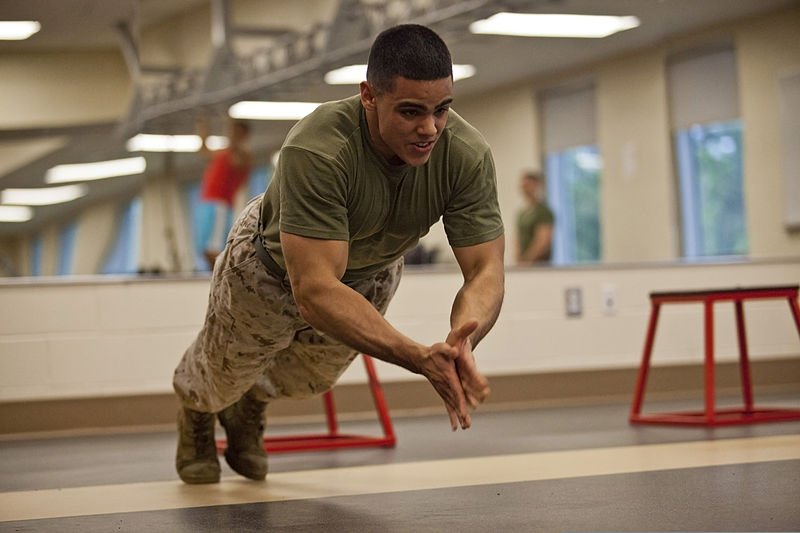
The chest is one of the most important muscle groups on the body for functional strength. It is not used in isolation, but it is a huge contributor to force output, much like the Glutes. Developing the pectoral muscles (lower/minor, middle and upper/major) can help you be more functional and powerful as a warrior. Training the whole chest will require compound movements with different angles, weights/resistance, and rep tempos depending on the quality you are attempting to develop.
THE ROLE OF THE CHEST IN FIGHTING
The chest is deeply involved in giving a warrior the ability to push, hold, and support/restrain. The chest assists the shoulder and arm in forward and internal movement. Specifically, it assists in flexion of the shoulder joint, adduction (inward pressing), and medial rotation of the Humerus (inward rotation of the forearm toward the midline of the torso). The chest also supports and stabilizes the Scapula (shoulder blade), allowing for efficient energy transfer from the lower body to the upper limbs, essentially helping with transverse (rotational) force during a punch. Essentially the chest is essential for maximizing the hitting power of the punch by making the mechanics of the punch for efficient by facilitating hip rotation, scapular stability, and arm extension.
THE THREE MUSCLE FIBER TYPES
There are three types of skeletal muscle types, and each of them serve a different purpose that deserve your consideration.
TYPE I
This fiber type is your slow-oxidating fiber that I like to call your “marathon” muscles. This is the stuff you use for endurance exercises like long distance jogging, and it is the stuff that you use to keep yourself upright without even thinking about it. You are using these muscles when you are standing in a defensive stance, deflecting blows, restraining an individual in a clinche, balancing during a kick, aiming a firearm steady, and whenever you are staying in the fight for more than a minute.
TYPE IIA
This is what I like to call your “strength muscles”. These are the ones that you are using primarily when doing repeatable strength exercises in the 5 rep range. This is the stuff you use when kicking hard, punching, manipulating joints, and generally grappling. This is a fast twitch fiber that uses oxidative phosphorylation (aerobic) and phosphogen (anaerobic) energy systems, which is what gives you that level of multiple rep endurance.
TYPE IIX
This is your ballistic muscle fiber that runs almost exclusively on your Creatine Phosphate energy system. This is responsible for your most powerful movements and your one-rep max capability. These fatigue the fastest, but are instrumental in delivering powerful blows during strikes, overpowering and opponent, and moving yourself or something/someone else quickly.
TRAINING THE CHEST OPTIMALLY
The chest, like any other muscle group, will respond to mechanical tension, time under tension, and volume. Different exercises and different tempos will effect the muscles differently and activate certain muscles. For example, if you want to train power, you need to lift heavy and fast generally. If you want to train endurance, you need to find a rep range or time window that allows you to get high rep ranges that is difficult, but not a true struggle that will turn it into a strength exercise. It is all about finding that optimal effort and force development.
TYPE I EXAMPLE
If I am wanting to get better at aiming a pistol, I will pinch a weight between my hands and hold it at eye level for a period of time that is optimal for training my Type I muscle fibers. I would generally hold a position for a set amount of time and give an equal amount of time for rest before doing another set of holds. For example, I would hold the weight for 45 seconds and then rest for 45 seconds. This would be done for 3-6 sets.
Generally, Type I muscle fibers can handle a good amount of volume, and will respond well to it, to a point.
TYPE IIA EXAMPLE
In order to generate the force required to target the fast twitch muscle fibers of the chest, I like to either leverage my bodyweight or add a weight that I have to manipulate vigorously. This can take practice for individuals to get used to. For example, if I am wanting to train my chest for pushing, I will conduct an exercise like the Archer pushup where most of my bodyweight is having to be lifted and stabilized by one arm at a time.
This is not going to be time efficient, but it offers versatility in the ability to train the Type IIA muscles without equipment. Though, this method will take more time than pushing with both arms like in a bench press, you are getting a stability benefit that will translate to rotational power in your punches. You can make the tempo slow or fast, depending on your mood and ability to effectively stabilize your shoulder and use it in unison.
When doing a strength exercise, generally it is best to stay in the 4-8 rep range for maximal targetting of the Type IIA muscle fibers. I recommend a mild recovery in between based on feel alone instead of time. Wait until you feel about 80% recovered. This will help you generate strength endurance and work capacity, which is essential when developing your chest for throwing bunches of punches. Aim for 2-4 sets of this type of training initially, and raise to 6 sets maximum after you feel like you easily recover and don’t experience DOMS (Delayed Onset Muscle Soreness) after 4 sets of intense training.
TYPE IIX EXAMPLE
Generating ballistic power is all about ‘how much, how fast’, or going from 0 to 60 in the least amount of time and staying at top speed for as long as possible. After you get to top speed, any deceleration is a symptom of you not using your Type IIX fibers, and switching to Type IIA. This is the sign to recover and prep for the next set. My favorite way to train the Type IIX fibers in the chest is through medicine ball punch throws.
I prefer a 15lb medicine ball and I use them on the corner of my brick house. The throwing side leg should be back, as the strong side in a powerful punch would. Stand in a bladed fighting stance and use one arm at a time to horizontally slam the medicine ball into the wall as if I am intending to destroy it. This closely mimics a punch and looks like a horizontal shotput into the wall, and allows you to generate maximal pushing force on each side using hip rotation, just like a punch. On the rebound, catch the ball, immediately change footing, and repeat the action with the other hand. This repeats until I lose power, not until I fail to do the reps at all. I stop when I lose the snap and forceful vigor in my throws. After this I wait until I feel 100% recovered before I go again.
If you are not accustomed to this type of training, I would Highly encourage you to look at my article on the Power Protocol that Pavel Psatsouline designed for his book ‘The Quick and The Dead.’ I am hijacking his training philosophy for power training in order to train these ballistic fibers, and I have made terrific progress.
WRAPUP
Training your chest is not something that can be done with a single exercise. That kind of myopic thinking leaves a lot on the table, and can leave you underprepared and undertrained compared to if you added a functional element to your training that targeted the specific muscle fiber types needed for self defense.