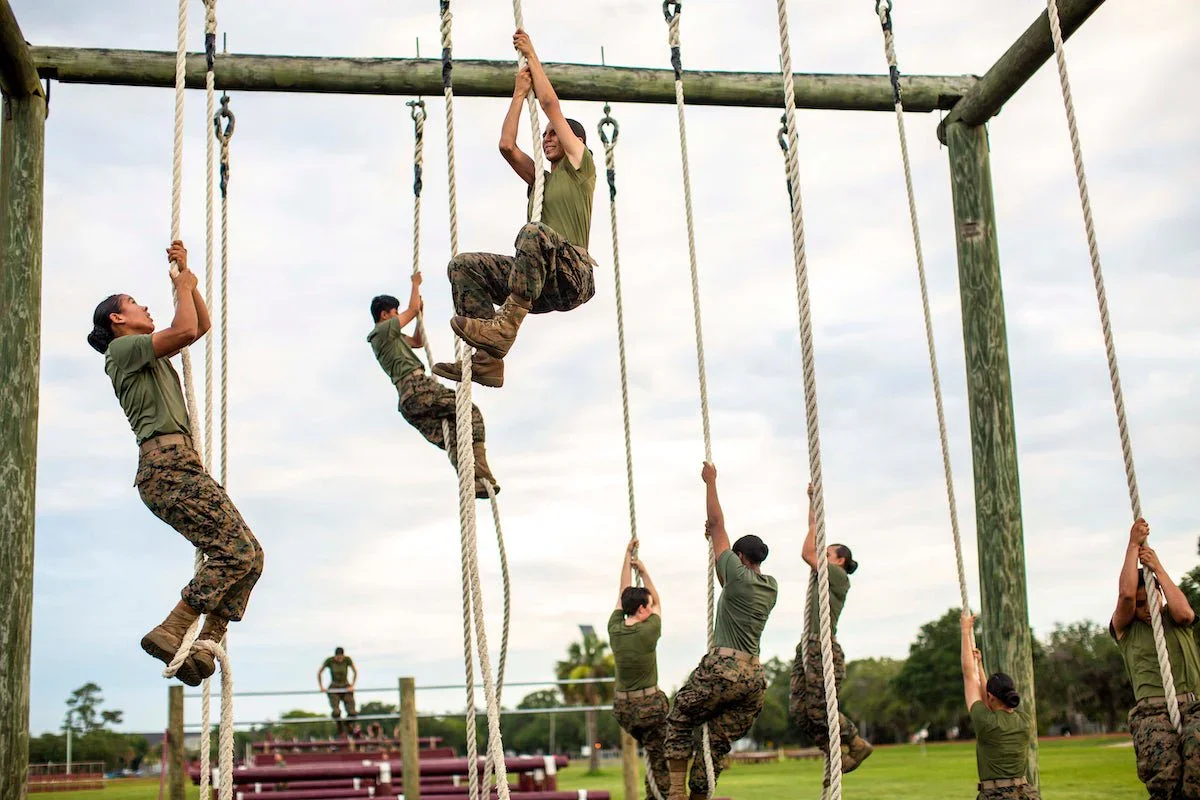
In the world of functional fitness, few exercises present as much challenge as demanding bodyweight manipulations. The king of pulling movements is often cited as the pull‑up, but I would argue the true master of upper‑body pulling is the rope climb — a full‑body, grip‑intensive test that taxes strength, coordination, and endurance in ways a single pull‑up rarely does.
PULLUPS VS LEGLESS ROPE CLIMB
Traditional fitness has hailed the basic pullup as the heavyweight champion of bodyweight training. In this exercise, you are doing a lot with pulling from a relatively stable platform, like a pullup bar. In general, there is not too much stability needed, nor too much grip strength due to you using a basic hook grip around the bar. The majority of the strain is at the top of the bar, and that is very temporary since the idea of the pullup is numbers of reps not time under tension. Though the pullup is not easy to get a lot of reps in, its method of working the upper body is through repetitive full range of motion Concentrics and relatively controlled eccentrics. In effect, there is a momentary ‘rest’ at the bottom of the exercise.
In the legless rope climb, the rope is unstable, generally about 1.5” around or wider, and vertical. This requires you to have a hard grip the whole time because the challenge is using your bare hands to prevent yourself from sliding down the rope. You have to keep yourself stable while the rope is swaying and spinning. This requires constant core stabilization, and kipping will make the climb harder and just result in blisters and a chewed up forearm compensating against undisciplined form. Lastly, you have the endless vertical pulling where you are pulling down and trying to keep the rope close to you. Each time you reach up to grab hand over hand on the rope, you are going to be holding yourself up with one hand until you grab the rope. Once you reach the top, you have to control your descent in reverse, not letting your hands go too far above your head.
MUSCLES WORKED
While pull-ups primarily target the latissimus dorsi, biceps, rhomboids, and rear delts in a relatively predictable pattern, legless rope climbs turn the dial to 11 by adding instability, thicker grip, and zero leg assistance. This forces a massive recruitment across the entire upper body and core:
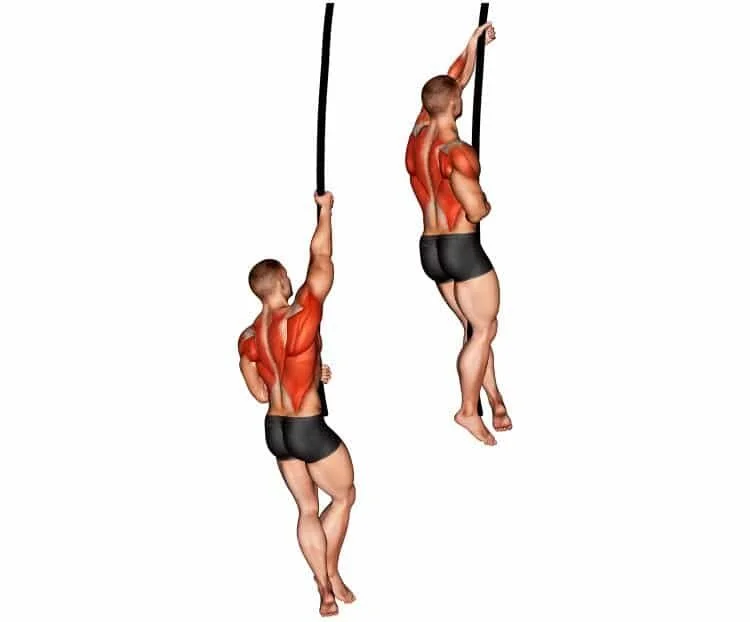
Forearms and Grip: Crushing strength demanded constantly—no hook grip security means your finger flexors, brachioradialis, and extensors are in isometric hell the entire climb.
Biceps (both heads) and Brachialis: Heavy elbow flexion on every reach and pull, plus the varying angles create insane pump and soreness near the elbow insertions.
Lats, Teres Major, and Rear Delts: Primary pullers, but working harder to keep your body close to the swaying rope.
Chest (Pecs) and Serratus Anterior: Shoulder stabilization and protraction as you hug the rope tight.
Core (Rectus Abdominis, Obliques, Transverse Abdominis): Relentless anti-rotation and hollow-body tension to prevent swinging—often the surprise soreness you feel the next day.
Shoulders and Traps: Scapular control and depression under full bodyweight load.
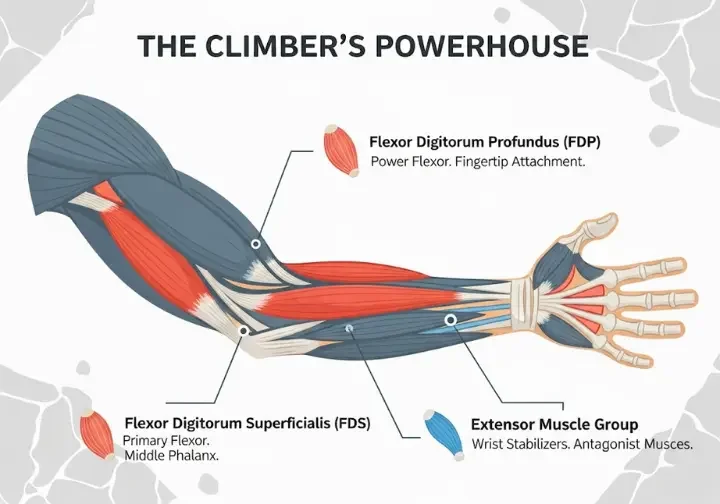
The result? That signature climber forearm pump and full-arm burnout that pull-ups rarely match.
REAL-WORLD CARRYOVER
While pull-ups build impressive gym strength, legless rope climbs forge the kind of raw, chaotic pulling power you actually use outside the weight room. The constant tension, thick-grip crush, instability, and full-body lockdown mimic real scenarios where failure isn't just a missed rep—it's a fall, a loss of control, or an inability to act.
Here’s how rope climbs directly translate:
Emergency Escapes & Rescues Firefighters, military personnel, and first responders often climb ropes (or equivalent structures) to reach upper floors, escape floods, or extract others. The legless variation trains the worst-case scenario: when your legs are injured, trapped, or you can't wrap them for leverage. That hand-over-hand grip endurance and core stability can literally be lifesaving.
Climbing Over Obstacles Think urban evasion, parkour, or obstacle races (Spartan, Tough Mudder): vaulting walls, scaling fences, or pulling yourself onto ledges. Rope climbs teach you to pull your full bodyweight dynamically while maintaining control—no clean bar, just whatever you can grab.
Grappling & Combat Sports In wrestling, BJJ, or self-defense, controlling an opponent often involves pulling them in while resisting their pushes. The rope’s instability forces anti-rotation and grip fighting under fatigue—exactly what happens when someone’s actively resisting. That "hug the rope close" instinct translates to clinch control and underhooks.
Manual Labor & Outdoor Work Construction workers hauling up tools, arborists managing lines, sailors handling rigging, or rock climbers on actual rock—all demand sustained thick-grip pulling with body tension. Rope climbs build forearms and lats that don’t quit after 30 seconds.
Everyday Functional Wins Pulling yourself up a tree to rescue a kid’s drone, hauling luggage into an overhead bin without straining, or dragging heavy objects—rope-trained strength makes these feel effortless.
Visual examples of real-world rope use that your training directly prepares you for:
Pull-ups make you strong in a controlled environment. Rope climbs make you capable when things are unstable, heavy, and urgent. In a world where strength often needs to show up unannounced, the rope doesn’t just build muscle—it builds readiness.
VERTICAL PULLING MASTERY WITH A PULLUP BAR ONLY
If you don’t have a rope (or the space for one), you can still chase that same relentless tension, crushing grip demand, and functional pulling strength using only a pull-up bar and a single thick towel. By draping the towel over the bar and gripping the fabric instead of the metal, you will get a variant of vertical grip force. It is not going to be as hard as a real climbing rope, but it will provide pure forearm and finger crush on every rep.
Here are the most effective towel-on-bar progressions that bring you closest to the legless rope climb feel:
1. Towel Dead Hangs & Active Hangs
Drape one or two towels over the bar (two for extra thickness and instability).
Hang with shoulders packed down (active hang) or relaxed (passive) for max time.
Builds the exact isometric grip endurance and scapular stability needed to support your bodyweight without sliding.
2. Towel L-Sit or Tucked Pull-Ups
Grip the towels, raise legs into an L-sit (straight out) or tuck knees tight.
Perform strict pull-ups while maintaining the leg position throughout the entire set.
Forces constant core tension and eliminates leg swing—pure upper-body and hollow-body work, just like legless climbing.
3. Slow Towel Pull-Ups with Controlled Negatives
Pull up over 3–5 seconds, then lower over 5–10 seconds (or longer).
No pause at the bottom—immediately reverse into the next rep.
Removes the “momentary rest” of regular pull-ups and creates the continuous tension rope climbs demand.
4. Towel Concentric Lock-Off Holds with Alternating Reach
Pull up explosively or slowly until your chin is over the towel level.
Lock off strongly at the top (elbows close to body, shoulders depressed).
While maintaining the full lock-off position with one arm, slowly reach as high as possible on the towel with the free hand, grab higher, and transfer bodyweight smoothly to the new grip.
Alternate sides without dropping below the lock-off height.
This directly mimics the hand-over-hand reaching on a rope: one arm holds your full bodyweight isometrically while the other reaches and pulls to the next “rung.” It’s one of the closest bar-based simulations of rope climbing dynamics.
Sample Towel-Only Progression
Beginner: Towel dead hangs → Tucked towel pull-ups with slow negatives
Intermediate: L-sit towel pull-ups → Slow concentric + 5–10s negatives
Advanced: Multiple reps of full concentric lock-off + alternating high reaches without descending
Here are visuals of these key towel variations—thick-grip hangs, L-sit towel pulls, slow negatives, and especially the lock-off + alternating reach progressions:
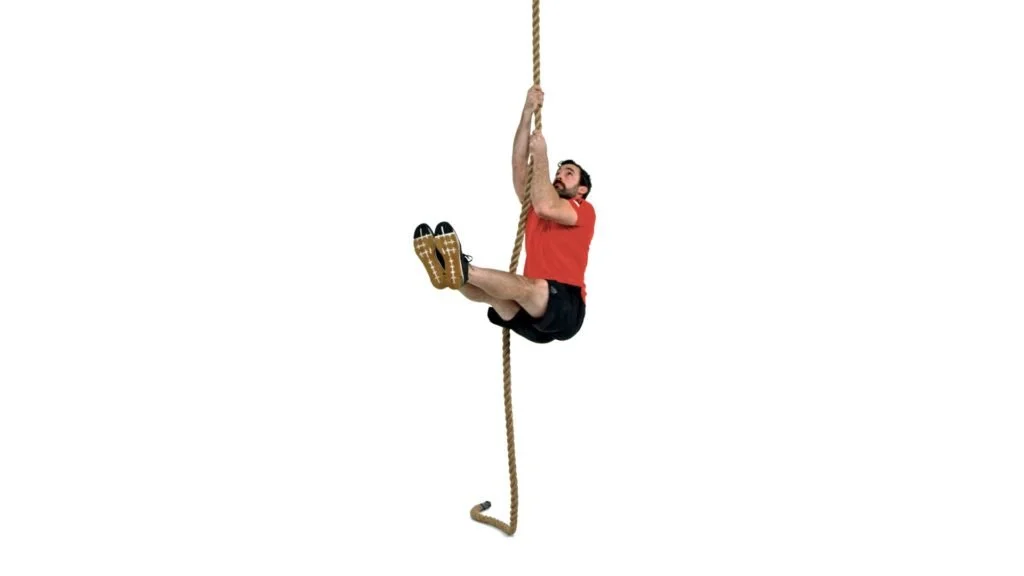
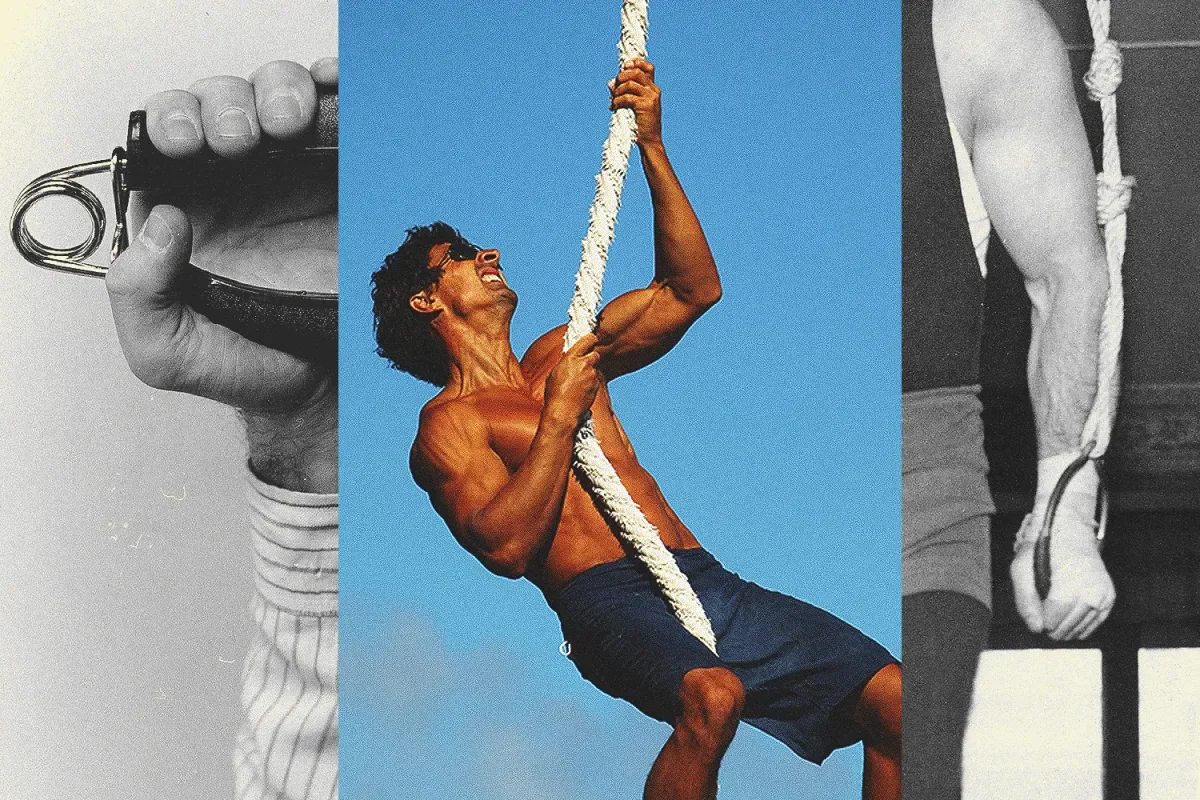

With just a bar and a towel, these movements capture the essence of rope climbing: thick-grip brutality, no-rest tension, core lockdown, and that critical one-arm reach-and-hold pattern. You’ll build forearms, biceps, lats, and functional strength that carry over directly when you finally get your hands on a real rope.
WRAPUP
Pull-ups are great—accessible, scalable, and effective—but for true functional pulling power the legless rope climb wins. Its thick grip, constant tension, instability, and nonstop demand on forearms, biceps, lats, chest, and core build usable strength you can’t get from a bar alone.
Use variations—leg-wrapped climbs, horizontal rope pulls, or towel progressions on a pull-up bar—to train the entire pulling system. Hang a rope, drag a sled, or drape a towel over your bar. Train often, make it playful, and expect soreness and gains until pull-ups start to feel easy. The rope demands everything and delivers lasting capability. Climb often.