The Double-Stack Micro-9 Hype Part 1: My Journey
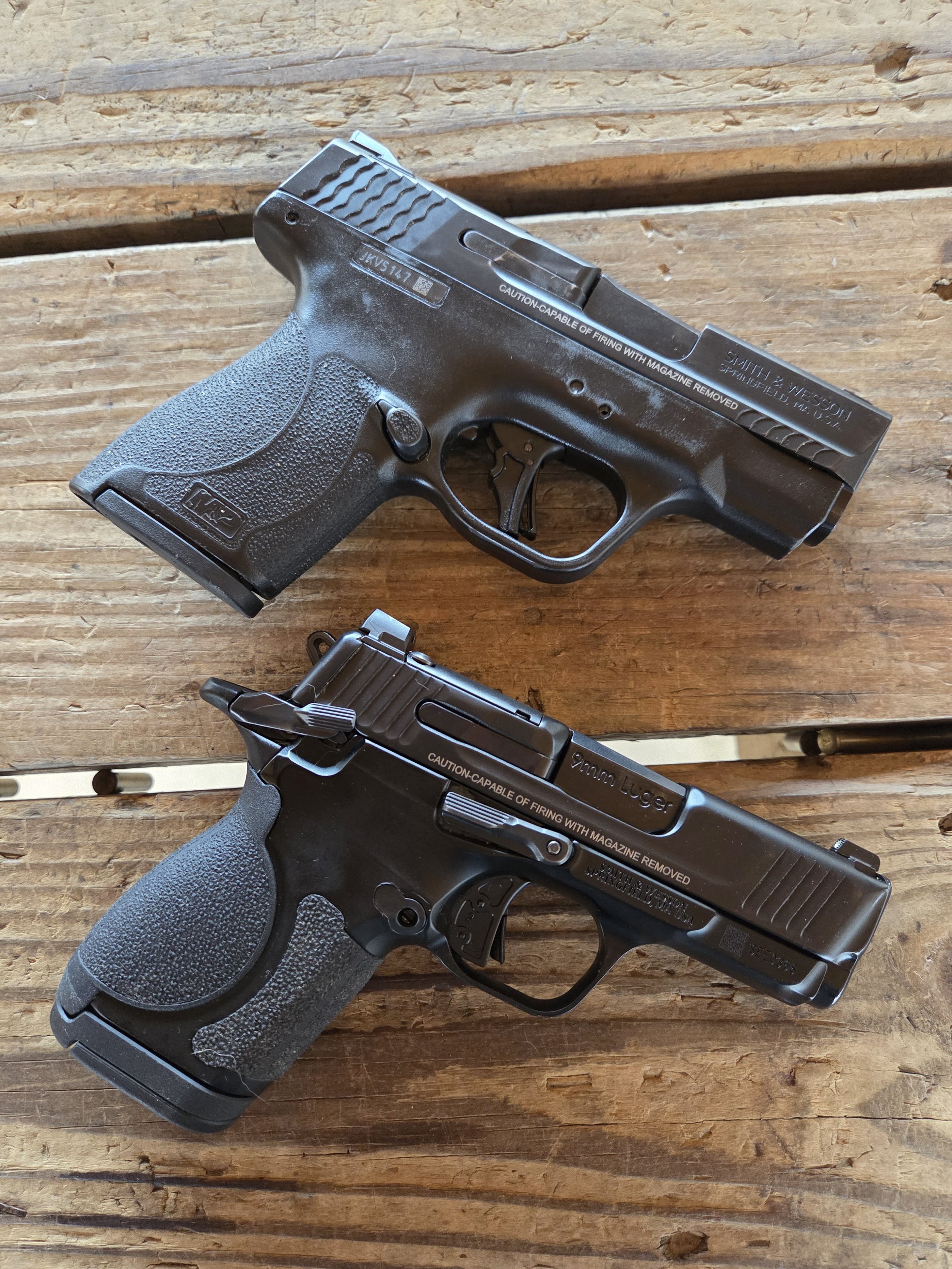
Everyone’s chasing the double-stack micro-9 right now — P365, Hellcat, Shield Plus — like it’s the holy grail of everyday carry. More rounds in a tiny package, “carry anywhere,” revolutionary. It honestly sounds perfect on paper and like a common sense concept. I bought it initially too, but I was wiling to wait it out initially after the P365 came out to see if there were bugs….and there were many. But then S&W released their Shield Plus, and I fell into that market as a trusting buyer.
I wrote articles calling the M&P Shield Plus the new standard, and in many ways it is the most basic micro 9mm on the market. It is the reliable M&P Shield but with a double stack magazine. After thousands of rounds of real-world ammo and real-world training, I walked away. I’m back on single-stacks, and I am not going back until a real option presents itself. Here’s exactly how it happened.
THE BEGINNING OF THE END
I started with the original M&P Shield. It was slim, light, reliable with the soft stuff most people shoot at the range. I loved it because I would shoot a lot of light practice loads myself. It felt like the perfect balance. It was super concealable without being a toy. When the Shield Plus dropped with that double-stack capacity and the flat-face trigger, I thought “this is the evolution.” I picked one up, ran it, and wrote it up like it was the future. But even in the first range session the flat trigger was a red flag. My finger was not able to disengage the trigger safety with fidelity, nothing like the crisp hinged trigger on the original Shield. I told myself “you’ll get used to it” and trained through it. I posted about how “modern” it felt. Deep down I knew something was off.
Smith & Wesson seemed to be chasing Instagram cool instead of the military/police contracts the whole M&P line was built for. The original M&P name meant durable, reliable, shootable for duty. The Plus felt like it was built for civilians who wanted to look tactical on YouTube and feel good while plinking at paper. That wasn’t my way, and it is where the friction really started. You cannot design a gun to feel good on the flat range with mouse fart loads and expect it to be shootable in a combat setting.
THE RED PILL MOMENT
Shortly after getting the Shield Plus, I moved down from Alaska to the lower 48 and changed my ammo diet. No more range-only SAAMI-spec 115-grain FMJ mouse fart loads for me. I switched to Winchester 115-grain service-grade — the stuff that hits harder than standard +P and closer to +P+ punch. I ran it because I wanted to practice with something that kicks more than whatever I’d actually carry for self-defense. That way, real carry ammo would feel easy. Most people do the opposite — shoot mouse-fart loads at the range, then load hot stuff and cringe. I found that once I started training how I will actually fight, recoil and all, my capability skyrocketed. No longer was I filled with delusions about my capability or what a gun provided me.
After a couple thousand rounds the Shield Plus started showing its true colors. Recoil springs wore out faster than on any single-stack I’d owned. The gun flipped hard. My hand felt the bite and was red after a couple hundred rounds. The frame didn’t flex, but the slide slammed and the recoil control was just… gone. The original Shield was already on the edge of “barely shootable” with hot ammo, but the Plus made it worse. I could feel every bit of that lighter weight and thinner grip transferring straight back into my palm. No magic springs or segmented grips were going to cheat physics. Lighter gun = more hand punishment. Thinner polymer walls = less vibration absorption.
THERE HAD TO BE ANOTHER OPTION
I decided to look for other options that might be more shootable and gave the Beretta Nano (now the APX A1 Carry) another honest chance. I remembered how stupid-light the recoil felt on the original Beretta Nano. I ran the same Winchester service-grade through it. It ate it up without fuss and I received no hand punishment. I actually thought the ammo may have been a light loading until I took another shot and realized that the gun took the ammunition like it was nothing.
The heavy slide, thick chassis, and strong recoil spring spread the energy instead of bouncing it back. Same story with the Walther PPS. Built for a police contract (Police Pistol Slim, remember?), it tames +P and service loads like a bigger gun. European single-stacks were clearly engineered to NATO ammo standards and they hold up nicely to real carry conditions. American micros like the Shield line? They were built for a steady diet of soft SAAMI-spec range ammo. Push them with real defensive loads and they fold or beat the crap out of you.
BUT IS IT ENOUGH CAPACITY?
The more force-on-force and scenario training I did, the clearer it got. I solved every simulated threat with way under ten rounds — often five or six. Multiple attackers? Still handled quick. No reload needed. No drama. And here’s the cold truth most people ignore: if you ever actually use your carry gun in a self-defense situation, that gun is gone. Confiscated, locked in an evidence locker for years (sometimes decades). Home defense? Maybe it stays with you. But street carry? It’s temporary. So why chase 13+1 or 15+1 when eight rounds of solid 9mm has always been enough? Why carry a spare magazine to get to 24 rounds total when real shootings end long before you empty the gun?
I realized I’d been sold a bad bill of goods. The double-stack micro-9 wasn’t answering a real need — it was inventing one. “More ammo in a smaller package!” Cool story. But I could carry the APX A1 Carry at 6+1 or the PPS at 6-7+1 and solve the same problems with better control, better durability, and zero hand punishment. The double-stack wasn’t an upgrade. It was a compromise dressed up as progress.
That’s when I quit. I went back to what actually works: single-stacks that were perfected over 20+ years of real demand, not hype. No flat-trigger gimmicks. No capacity wars. Just guns that shoot when I need them to. If you think this is just my personal taste, wait for Part 2. Because it turns out I’m not the only one who walked away — especially the people who need every edge they can get.