MAC MEUSOC 1911: A COMBAT-READY CLONE
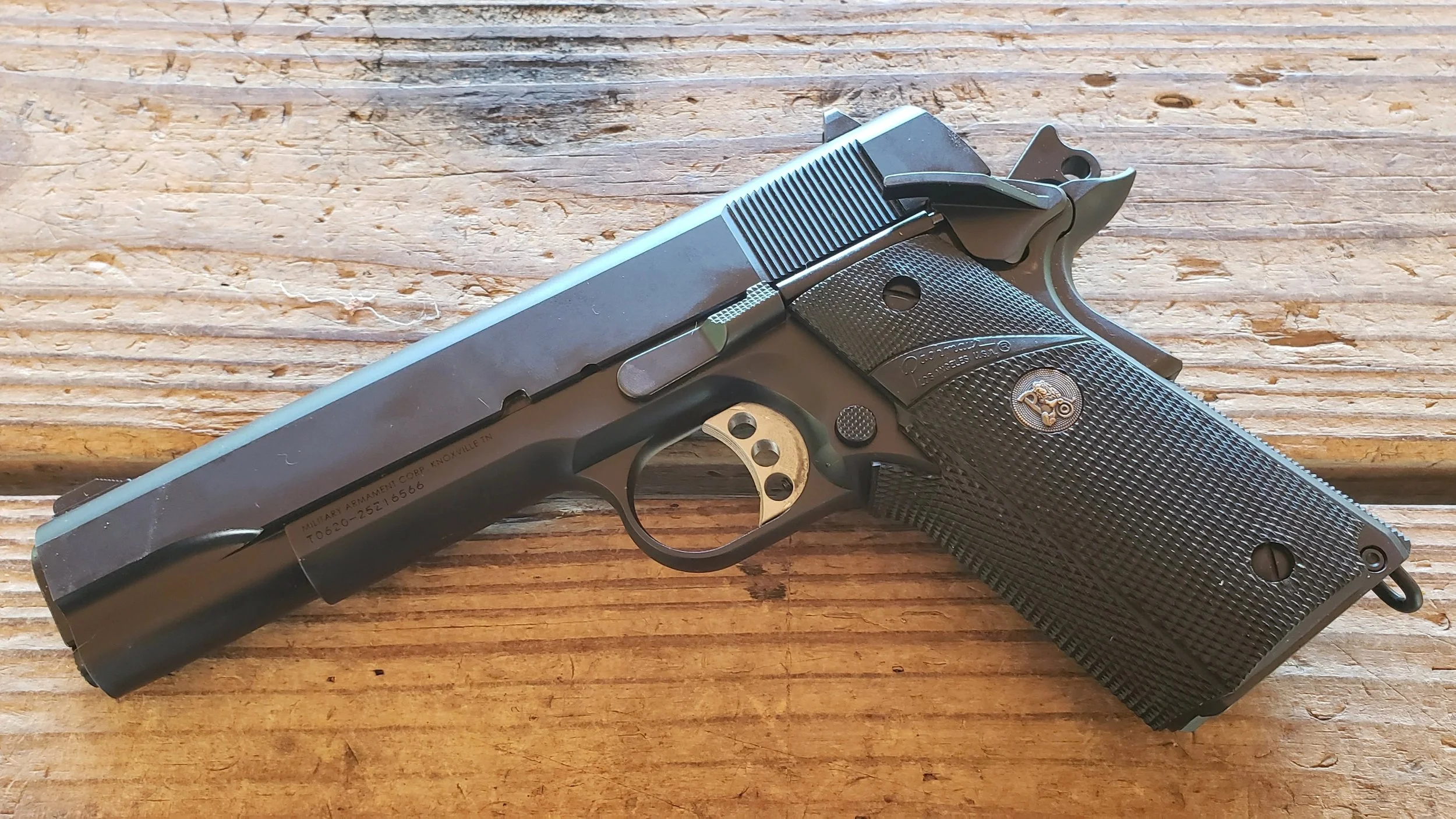
The MEUSOC 1911 from Military Armament Corporation (MAC) is a highly faithful clone of the classic 1911 pistol used by Marine Recon units, specifically chosen over the newer Beretta M9 during that era. When I saw that Military Armament Corporation released this pistol to the market earlier this year, I was chomping at the bit to get mine. Most MEUSOC clones are either custom built guns for thousands of dollars or are going to be a home build that you will have to make for yourself. For $600, you too can have a faithful clone of this legendary 1911.
ORIGINAL ‘MEUSOC’ FEATURES
When the armorers first got their hands on the 1911 pistols, they began making various modifications using any parts they could find or source. Each of these pistols was meticulously constructed using handpicked frames that were leftover and carefully selected from military armories. After selection, the frames were then expertly modified and refined by a custom precision weapons shop located in Quantico, ensuring high quality and hand-fitting in every firearm produced. During that time, their goal was to keep all the pistols as uniform as possible by using the same components whenever feasible. However, they often had to work with a mix of different parts from various manufacturers, including well-known names like Ed Brown, Wilson Combat, and others, resulting in builds that featured a diverse assortment of components.
The Marine armorers replaced the standard slides with Colt ‘Hard Slides,’ which were fully forged for enhanced durability and performance. They also made several modifications to improve handling and functionality, including the installation of flat mainspring housings, Pachmayr grips for better grip retention, beavertail grip safeties to reduce hammer bite, as well as ambidextrous and extended manual safeties for easier actuation. Additionally, the triggers were modified and lengthened to provide a smoother, more controlled trigger pull.
PHILOSOPHY OF USE
The MEUSOC 1911 is a terrific and reliable pistol that could easily be put into a home defense or concealed carry role with confidence. I have personally carried a full-size 1911 for many years without encountering any significant issues or drawbacks. The only important caveat to keep in mind is to ensure that the holster you choose is specifically designed to accommodate the ambidextrous and extended safeties. This will be a challenge for many people, and may require you to call the holster builder to send pictures and maybe some caliper measurements of the safeties, so they can make appropriate molds to fit your needs.
For home defense, I would prefer a pistol that contains a weapon light, but this is not an absolute requirement. I have several staged firearms that do not have lights on them. The one exception I would make is to consider having a trigger guard holster on your pistol. These things can be a first line of defense against an ‘OOPS’.
Last use you may find for this pistol is just as a collectors item. Nothing wrong with collecting a cool pistol that is legendary. This will also cost very little compared to the custom options out there. Custom 1911s are cools, but not for 5-10X the price of this MEUSOC from MAC. This would just be an easy way to have a classic firearm, like buying the $300 Tisas WW2 style M1911A1. You get all the features of the original, but without the thousands of dollars put into it. Also, no guilt for shooting or using it, like if you had a real used pistol that was over 100 years old.
OBLIGATORY PARTS CHANGES
When I first get in a 1911, I like to test the springs and make sure that the pistols are properly sprung. It is common for manufacturers to cut corners and costs by using weaker or cheaper springs. For a manufacturers, even cutting down the price of each spring by $0.25 can save them a few thousand dollars when they are ordering 10,000 springs at a time.
The recoil spring on this pistol was very good, right out of the box, which is very uncommon. Usually you will find the recoil spring to be either shorter or thinner than the 18lb springs from Wilson combat.
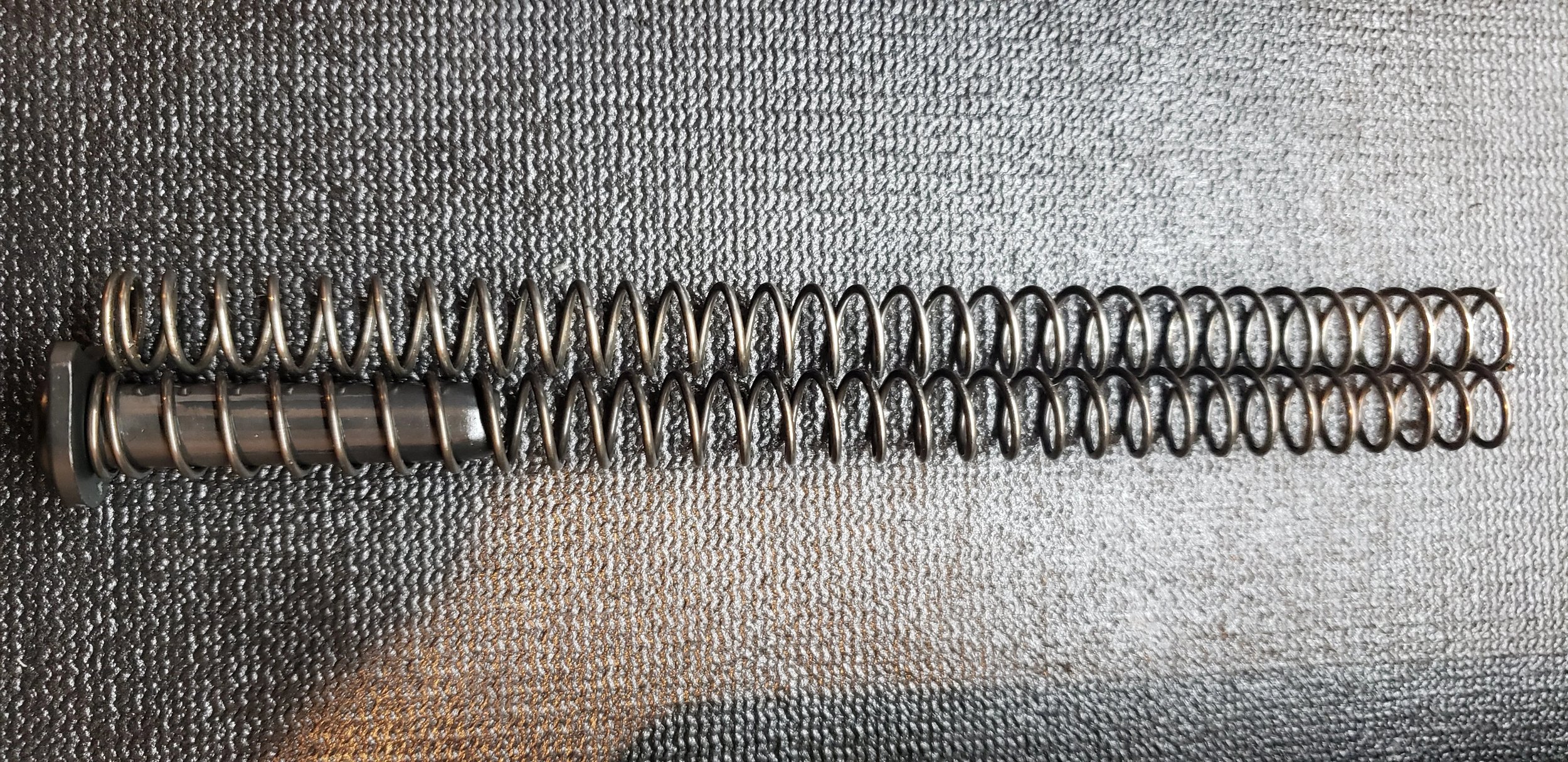
The spring with the recoil rod is the stock recoil spring. The spring on top of it is a Wilson Combat 18lb Chrome Silicon Recoil Spring
Another spring I like to check carefully is the hammer spring, which is also commonly referred to as the Mainspring. According to specifications, this spring is supposed to have a tension of around 23 pounds. However, I found the tension on the hammer to be noticeably stronger, indicating the possibility of a mainspring that was heavier than the standard 23 pounds. This observation was somewhat surprising to me because, in my experience, mainsprings are typically not only shorter in length but also lighter in tension, usually designed that way to make cocking the hammer easier and more manageable.
Hammer spring tension not only affects the amount of force that the firing pin can apply to strike the primer effectively, but it also plays an important role in controlling the rearward movement of the slide. By helping to retard this movement, the spring tension effectively gives the brass cartridge case in the chamber additional time to cool down and shrink slightly. This cooling and shrinking process allows the pressure inside the bore to diminish before the extraction cycle begins. As a result, this mechanism promotes more consistent and controlled ejection of spent casings during the firearm's cycling process.
The last spring I checked was the safety plunger spring. This spring will affect the positive actuation of the manual safety, but also will apply downward pressure on the sldie stop lever. This spring tension is highly important because the slide stop inevitably will be hit by a round that is walking up the magazine during cycling. A loose plunger spring will allow the slide stop to be bumped up and thus lock open the slide while there are still a few rounds left in the magazine. The plunger spring on the MEUSOC was a bit light, from what I saw.
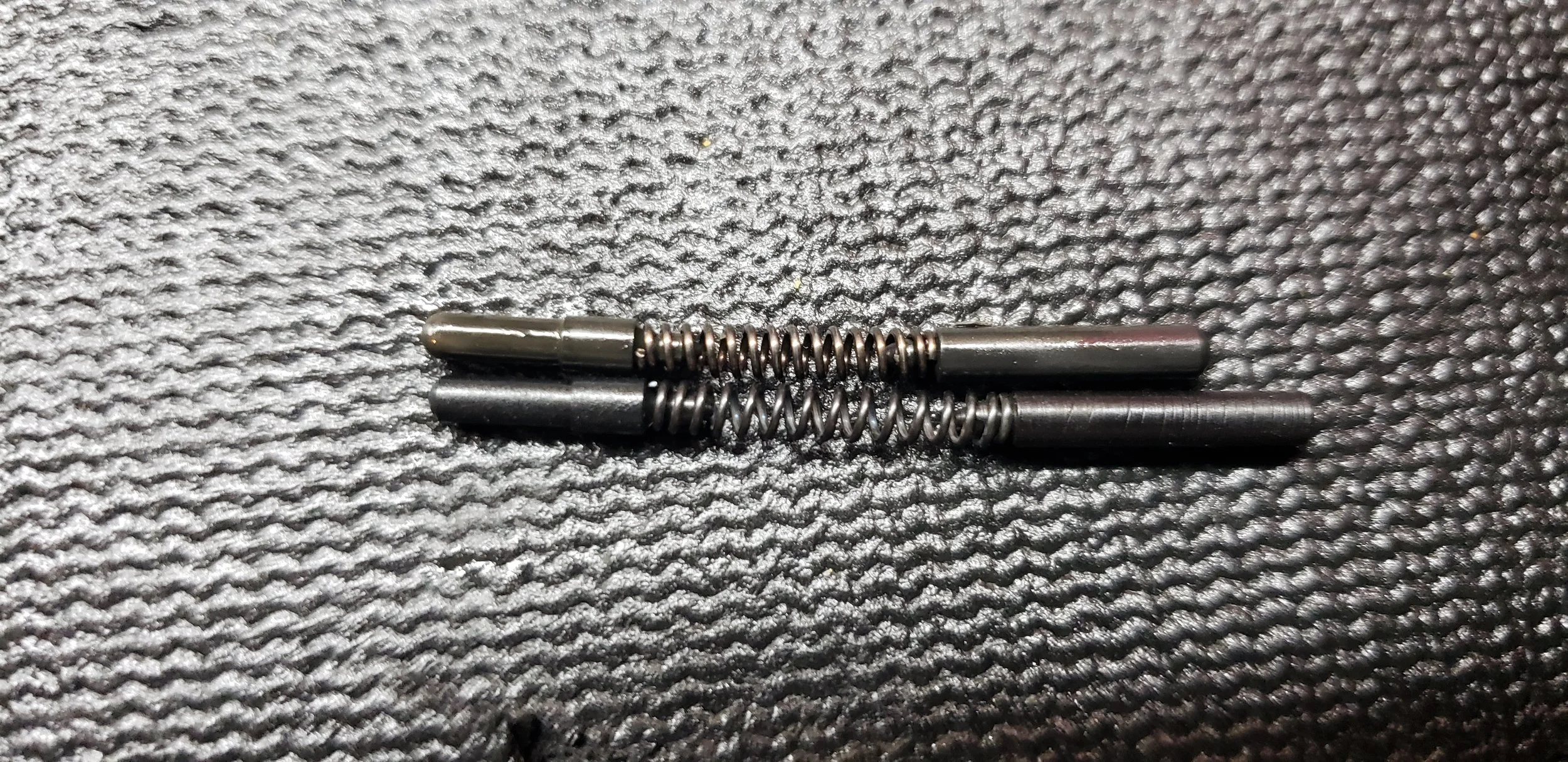
The springs were not necessarily thinner than those in the Wilson Combat spring set; however, they were noticeably shorter in length, which resulted in less overall tension compared to the Wilson Combat springs. Due to this difference, I decided to replace the entire plunger set with the Wilson Combat blued set for better performance and reliability.
SHOOTING EXPERIENCE
On my first range experience, I was a bit concerned that I would experience a firearm-related stoppage, but all I got was a stoppage out of one of my Wilson Combat magazines. This was a malfunction very common to 8-round magazines with tilting followers. This stoppage happened twice with the same type of Wilson combat magazines, which is evidence that the tilting followers are the culprit. The 7 round and non-tilting 8 round magazines were all reliable. However, on one of my worn Wilson Combat 8 round magazines, the last round in the magazine did eject with a spent case, clearly showing the age of the magazine. That particular Wilson Combat magazine had been in usage since 2013. Time for a new magazine spring, it would appear.
Ejection out of the MEUSOC 1911 is slightly erratic, which is completely fine by me. The ejection port is not lowered and flared, which means it will not be easy to get the ejection completely perfect or consistently neat. I know a lot of people want perfectly tuned extractors that can make all the brass land in a perfect pile every time, but for my purposes, I just want the brass to reliably eject without fail. This is exactly what it does for me in practical use, so I have no issues with it whatsoever.
The sight picture on this pistol is completely blacked out, which is true to the original MEUSOC 1911’s . The front sight is staked on and serrated to mitigate glare, which works out perfectly for my uses. Recently I have used the original GI WW2 iron sights on my M1911A1 by Tisas. I have found the original 1911 GI sights to be incredibly precise and very easy to use. I used to be deeply worried about having blacked out sights on my pistols, but I think that I now prefer them for quick combat accuracy.
The trigger on the MEUSOC is very crisp right out of the box. It is insane how little takeup and overtravel there is right away. The trigger has zero creep whatsoever, which is quickly becoming a standard feature on these Turkish-made 1911s. It feels a lot like my Springfield Operator, and it is using a stainless skeletonized adjustable trigger. It feels like you are shooting a well tuned and semi-custom 1911, which is very deceiving when you learn that you have only spent $600.
MAINTENANCE CONSIDERATIONS
On the MEUSOC 1911, it is important to set it up right if you are going to get the genuine experience. You already have a forged slide and frame, and quality internals that are well fitted. When it comes to springs, you will do well to make sure that your 1911 maintains an 18 pound recoil spring that is changed out every few thousand rounds. The mainspring should be at least 23 pounds with a firing pin spring that is extra powered, with a titanium firing pin, if able.
Having all these springs readily available is relatively inexpensive, especially considering the peace of mind it provides. I would confidently wager that most people will only need to acquire two complete sets of all the springs used in their 1911. Typically, one set is required for the initial setup and break-in period, and then a second set may be needed after approximately 5,000 rounds have been fired through the firearm. The way these experienced operators managed to keep their 1911s in such consistently good working condition was through diligent preventative maintenance at regular intervals. This proactive approach ensured reliability and longevity in the weapon’s performance.
Another part of preventative maintenance is properly lubricating your 1911. You do not need to disassemble your 1911 to lubricate it, thankfully. You just need to lock back the slide and lubricate the following areas:
Barrel (3 drops)
Disconnector (1 drop)
Disconnector recess on slide (1 drop)
Slide rails (2 drops each side)
After lubricating these areas, rack the slide 5 to 10 times and then liberally lubricate the barrel hood through the ejection port and run the action 5-10 more times. This lubrication method should happen every 100-200 rounds to keep the pistol wet. 1911’s tend to run way better when they are run wet and sloppy, from my experience.
WRAPUP
The MEUSOC 1911 by Military Armament Corporation is a faithful clone of the original 1911 fielded to the Recon community. The 1911 that Recon used had changed over time, and saw certain advances. This model is faithful to the older version and saw a good amount of use in the Global War on Terror. I cannot emphasize enough about the value of this pistol. For $600, you are getting a pistol that feels semi-custom and hand-fit, just like the real MEUSOC 1911s.