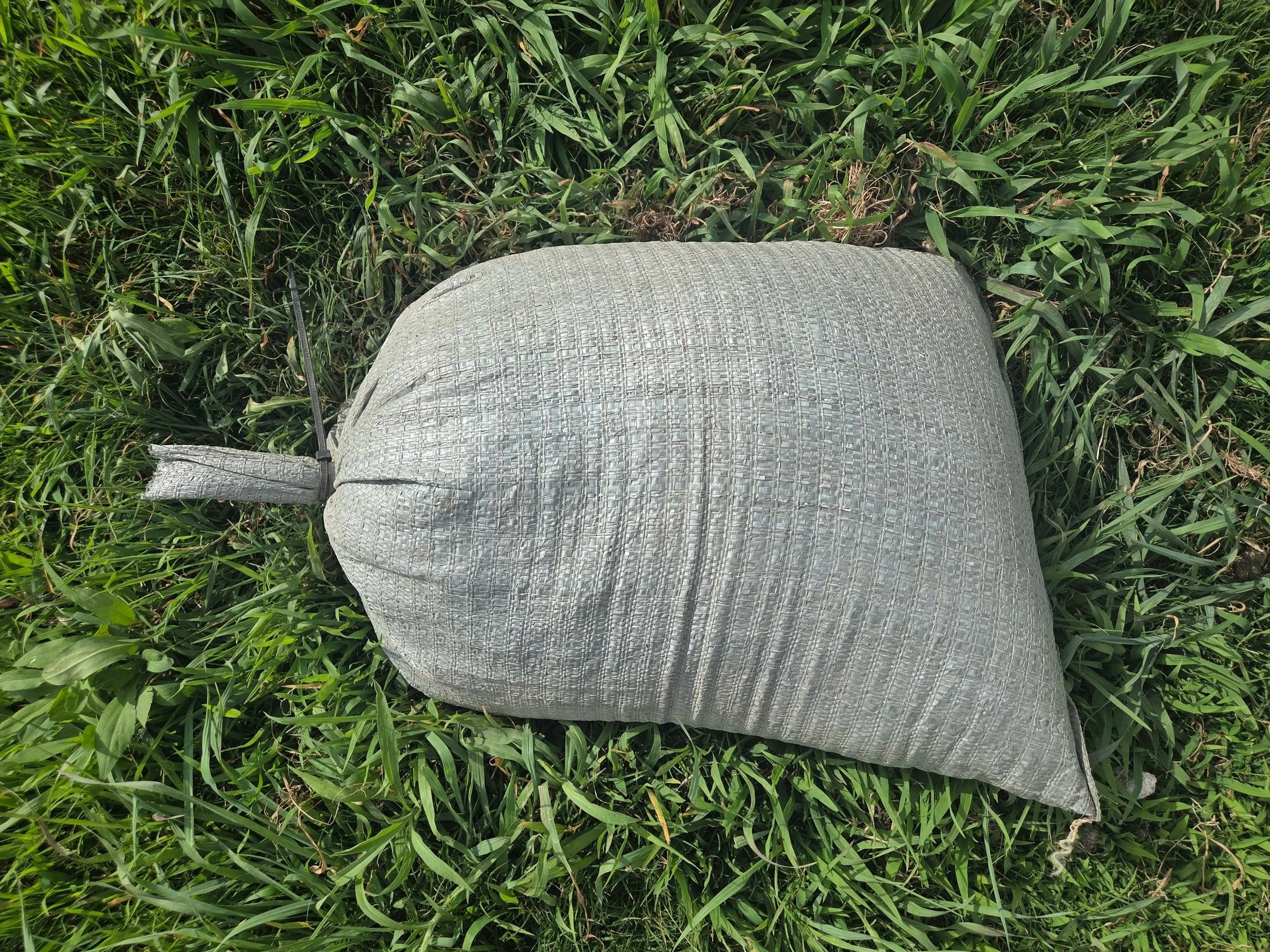
The sandbag is a simple tool that can have a major impact on your physical conditioning. It can be filled with soil and packed tight to create a dense and awkward object that you can hold, carry, and manipulate to develop strength, power, and endurance. This tool is terrific for simulating log PT and conditioning you for light infantry-style operations. I would promote the use of the sandbag in any PT program for the unique benefits it offers, much like the kettlebell or the medicine ball, which I have previously covered, as well.
COMPARABLE EQUIPMENT
A sandbag, for the purposes of the majority of this article, is the standard military sandbag used to build and reinforce fortifications. This style of sandbag is in a league of its own in terms of providing a relatively unaccommodating weight for exercise. These bags of tightly packed sand and/or dirt can weigh about 50lb +/- 5lb, which is very similar to the weight responsibility of each person during log PT. Needless to say that the sandbag is a terrific way to simulate log PT on an individual level.
Another type of sandbag is the long duffel bag style ones you can load up with smaller sandbags to have a mass of unaccommodating weight. These are great for simulating lifting bulky equipment, carrying people, hefting around bags of equipment, etc. Pat McNamara is a fan of using these types of sandbags for power development. More on this later.
ASSEMBLING YOUR OWN SANDBAG
You can get the duffel bag variety of sandbag from an online vendor, or you can make one yourself by buying something like an old military duffel bag, surplus rucksack, etc. I personally use an old flight bag that I was issued in the Marines.
All I did was load the bag up with soil and broken bricks (leftovers from my house being built) to create a bag that is heavy and unaccommodating. I just zipped up the bag and that was it.
For the conventional sandbag, you can get a pack of 25, 50, 100 almost anywhere. You can load them up with playground sand from your hardware store, or fill dirt from your yard. I chose the latter since it was free and we dug a lot for trees. Just make sure you don’t include too many rocks.
Most sandbags come with a sort of twine to tie off the end, but I use a double zip tie method.
For added security, experts like Stew Smith recommend duct taping your sandbag for longevity and securing the ballast inside. This is typically not used on sandbags that are fully loaded, but those that are half or three quarters full (30- 40lb) of sand. This creates a smaller object they call a “sand baby”. They can be lifted, thrown, carried, or shoved in a ruck as extra burden.
HOLDING THE SANDBAG
Much like any other conventional weight system, the sandbag is held in a particular way, depending on the exercise, in order to encourage stress and tension to be applied to certain parts of the body.
Chest Carry
This hold can be either high (chest level) or low (elbow level) and can be against the body or away from the body (like an offering).
This is a common position for Log PT and carrying items. This will work the lower back and the biceps.
Bear Hug
This is self-explanatory and is completely reliant on your ability to keep tension on the sandbag. For a conventional sandbag, there is not much contact surface, so any slippage will cause a problem.
This exercise is great for when moving or just a static hold as it tests the chest and arm endurance and simultaneously can exercise your lower back stabilizers.
Underarm Carry
Carrying this weight under the arm on either side is a challenge for the arms and frontal plane on either side.
Add in movement or leg exercises for a greater challenge to the stabilizers.
Suitcase Carry
This is basically where you just hold the sandbag in one hand by the tail and carry it.
This can be difficult for the obliques to keep you upright and can strain the grip as well. Push the sandbag away from the body to increase the challenge.
Shoulder Carry
This is a fundamental position for hauling heavy objects.
This provides a greater challenge to the frontal plane during movement, depending on weight, closeness to the head, etc.
Overhead Carry
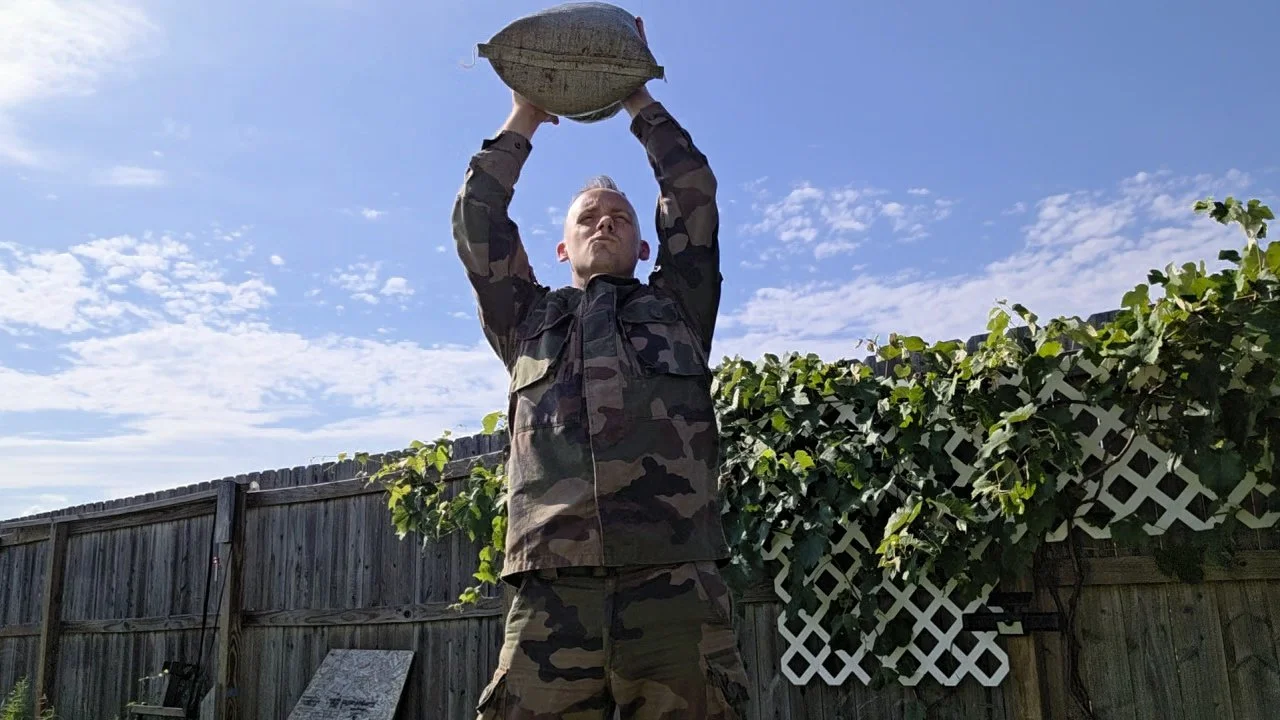
This carry technique is very unstable and puts a high amount of strain on the core and shoulders. Much like a lever, the further up you hold the sandbag, the greater the challenge.
Add this technique to movement and leg exercises to maximize the challenge.
SANDBAG EXERCISES
Overhead Press
Start on the left/right shoulder, use both hands to lift the sandbag above the head and as high as possible and lower down onto the opposite shoulder. For a four-count exercise, do this four times for one repetition.
Forward Bend
Start with chest carry. Stand straight up and bend forward at the waist until your elbows touch your thighs, then stand straight up with back straight. For four-count exercise, do this twice for one repetition.
Straddle Jump
Hold the sandbag high above your head and start with feet together. Jump and balance the sandbag above your head while jacking your feet to shoulder width and bend knees slightly to absorb shock. Jump again immediately and bring feet back together. For four-count exercise, do this twice for one rep.
Side Benders
Start with the sandbag on your left shoulder, feet shoulder width apart. Bend to the left as far as possible and then back up straight. For four-count exercise, do this twice for one repetition. Switch shoulders and do same process for other side for uniformity.
Deep Knee Bends
Start with sandbag in chest carry or on a shoulder. For more of a challenge, hold sandbag far above your head. Bend knees and do a ¼ squat, hold for one second or more. Then bend knees ½ way and hold for at least a second. Finally bend knees as far as possible and hold for a second before standing up as fast as possible for one repetition. For a greater challenge, jump as you stand up.
Overhead Toss
Start on the left shoulder. Perform an overhead toss about a foot above your head and catch the sandbag, bending the knees and bringing the sandbag down on the opposite shoulder. Toss the sandbag up again and bring it down to the original shoulder. For a four-count exercise, do this twice for one repetition.
Walking Lunges
Start with the sandbag in a shoulder carry or in chest carry. Take a step forward with the left leg and touch your right knee to the ground before taking another step with the right foot and touching your left knee to the ground. Stand straight up for one repetition. To make it more challenging, twist your torso right when stepping with the left and twist to the right when stepping with the right foot.
Swings
Grab the sandbag by the tail and stand feet shoulder width apart. Press butt back and squat down. Start with sandbag arm’s length away and hike it between your legs one-handed and begin swings using your hips to drive the movement.
Curls
Start with the sandbag cradled at waist level. Curl the sandbag up to in front of your nose. Lower the sandbag down to waist. For a four-count exercise, do this twice. Limit your back movement as much as possible and put your back to a wall if beginning this exercise.
Load/Unload
Start with the sandbag on the ground at your feet. Have a four-foot platform or truck bed behind you. Squat down and lift the sandbag up and rotate the torso to set the sandbag on the platform as far behind you as possible without moving your feet. Turn the other way and pull the sandbag around and lower it to your feet with a controlled squat. Reverse the process for one repetition.
Sit-ups
Start in the supine, feet braced under something heavy. Hold sandbag in bearhug or above head for greater challenge. Lift shoulders and back off ground and then back down. For four-count exercise, repeat this twice.
Get-ups
Start in supine or on side. Use both hands and press sandbag in the air above your head and sit up. Gradually shuffle legs and get a knee under you as in a Turkish getup, balancing the sandbag above you the entire time. Reverse the process for one repetition.
Running/Carrying
Hold the sandbag on a shoulder, in a chest carry or above your head and walk or run with the sandbag. Faster is not always better, but it is a challenge to limit the contact time you have with your feet on the ground.
BENEFITS TO THE BODY
The sandbag is a versatile tool that can provide instability quite essential to core development. The core muscles are the stabilizers all around your torso that keep you upright. Most of these stabilizers are highly underworked and undertrained, even in professional athletes.
Most modern calisthenics and lifting programs are not only sagittal-based, but also centered around the visible muscles in the abs. This is a huge problem that becomes apparent in injuries from transverse movements and forward bending. Ironic how throwing your back out wasn’t really a thing back in the days when multiple planes of motion were the standard, from the early 20th century to the 80s in the military.
The awkward and dense nature of the sandbag is a convenient and functional tool that challenges the whole body, depending on the type of exercise you use. Exercise is all about angles of manipulation and rates of exertion. You can conduct isolated or compound exercises, and make life as difficult or as easy as you want.
I can attest to the fact that the sandbag is probably more effective than a kettlebell at developing a physique that most work hard to build. You don’t need a barbell or an expensive membership or even a complex program. Just a few lifts and some creativity.