CANTEENS: TIMELESS OR ANCIENT?
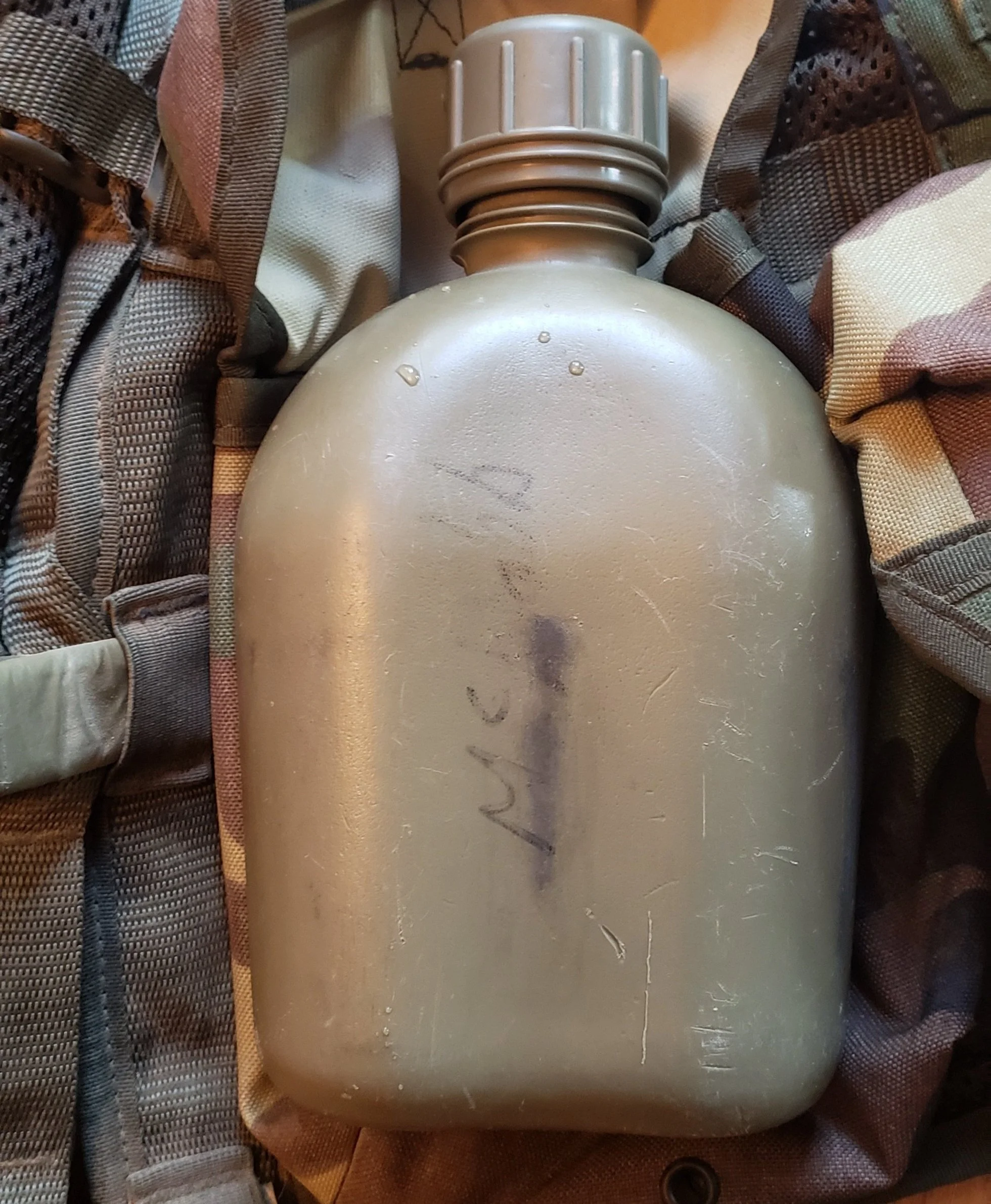
Canteens are an old school way of carrying water in the military. Today, canteens have been replaced by hydration bladders that are flexible and form fitting, but also can carry all your water in one easy-to-access container. The military has spent decades upgrading their equipment and trying to optimize stuff you make warfighting more convenient. But does this mean that canteens no longer have a place for us?
CAMELBACK ADVANTAGE
As an infantryman in the US Marines, I got to experience the burden of carrying water into combat first hand. It was one of the biggest burdens a Grunt had to endure, but we relished our water supply. You were willing to deal with the added weight, especially during the times when the temperature reached an oppressive peak of 130 degrees. I honestly spent most of my time carrying around a camelback on the back of my LBV.
A HOT TICKET ITEM
The Camelback was the newest and coolest way to hydrate during that time. Most of the people I fought with just attached our issued camelback system to the plate carriers and had 3 liters (3 canteens equivalent) of liquid on our backs, ready to sip on at all times. This was convenient, but came with it’s own host of issues. The bladders would burst at times, if you landed hard on it or ran with a heavy enough pack. Also, the sloshing from the extra air in the bladder was annoying as hell. In the heat, the water you first got out of the drinking tube would be boiling hot, and almost undrinkable for at least the first mouthful.
REFILLING CHALLENGE
Once you were out of water in your camelback, it would be a pain in the butt to refill it. For those that attached it to their plate carrier, they would have to take off their armor just to refill their water supply. I used the LBV we were issued so that I could still have my armor on while I was on post (guard), but be able to take off my LINE 2 gear (fighting load) when I wasn’t moving around a whole lot. I could have my water, ammo, and grenades within arms reach instead of weighing me down.
STILL A DISTRACTION
The argument of Camelbacks being more convenient and useful because it doesn’t require as much fiddling is non-sense in my experience. When you are patrolling, your focus needs to be on your sector, not sipping water or dinking around with things that distract from your ability to hold security. The point is that when I found myself sipping from my drinking tube, we would have easily been able to fiddle with a canteen as well.
AWKWARD TO CARRY
Having a camelback on my body armor also made carrying a ruck or assault pack quite awkward. And for those who would say to use the inside portion of the pack to store the bladder and just wear the bladder carrier, yeah no. The assault pack is already filled with ammo, an MRE, explosives, and other crap. I would not have enough room in the issued assault pack if I shoved the bladder in the pocket of the main compartment of the assault pack. Not to mention that the pocket seems to only really work for a Camelback bladder that is half full. That is just a ridiculous idea and it would require you to fiddle around with the bladder daily because of doing things like patrols, post, leisure time, etc.
CANTEEN USAGE
When I checked into Recruit Training Depot San Diego, I was issued two canteens and ALICE gear. We would not sip water from these canteens, though. Water consumption was to be all or nothing, not a leisurely event to be done casually. The rule was “If you are even remotely thirsty, you are to drink an entire canteen in one sitting. Your canteen will be either full or empty at all times.” This rule made to ensure chances of us suffering from dehydration were mitigated.
FORCED HYDRATION
If anyone was caught with a sloshing canteen or seen merely sipping water, the drill instructors would inflict ‘Hydration Training’ on the platoon. I fondly remember doing ‘Hydration Training’ one morning because our scribe was caught daintily sipping from his canteen by one of our Drill Instructors. We were then introduced to ‘Hydration Training” as a platoon instead of the scribe being subjected to individual IT (Incentive Training) on the Quarterdeck. Here is how it was inflicted-
The whole platoon was ordered online in the squad bay (open interior barracks).
All recruits were ordered to hold out a canteen with their arm locked out while at the POA (Position Of Attention). A full canteen got heavy as the Drill Instructors slowly explained ‘Hydration Training’ and what caused it to be necessary.
The recruits were ordered to chug the whole canteen in one sitting. Once finished, you were to hold the canteen upside down in front of you with a locked out arm, at the POA..
The entire platoon was ordered to the bathroom to hastily refill their canteens to the brim and get back online before the drill instructors finished counting down.
If any recruit failed to chug their canteen all at once, spilled any water, or any of the recruits were deemed to be too slow at chugging, the platoon repeated the process. Recruits always ended up puking up the water they chugged after about the third or fourth canteen. This practice was greatly feared by recruits because it was mainly used right after eating chow. This only happened twice in our platoon, and I don’t mean to brag, but I was one of only three that did not puke from drinking 5 canteens of water.
After boot camp, I used canteens rarely in the fleet. The camelback was the main piece of gear put on packing lists, and we did not have too much autonomy in terms of what we carried. The canteen was considered to be more of a backup option if the bladder ruptured or you needed to refill the Camelbacks we were issued.
Since I retired out of the Marines, I have experimented with canteens and found them to be just as functional as the beloved Camelbacks. Canteens can carry water in a small durable package. They are light enough to be placed on a pack or LBV without offsetting the weight too much. The 2 liter version is collapsible and handy for storing spare water in or on your pack. You can buy the 1 liter collapsible aftermarket canteens, if saving space is a huge priority to you.
The standard 1 quart/liter Canteen that we were issued happens to be almost the perfect serving size for field operations. If you apply the rules I was taught in boot camp. and consume a whole canteen at a time on a halt, you will find yourself feeling more ready and energized. You don’t necessarily have to chug like we dig during our ‘Hydration Training’, but take it down in one sitting.
I found out that this hydration technique is actually wisdom from before Vietnam. You are not always going to have time to dink around with a drinking tube while you are watching your sector, and sipping on water during field operations is not going to cut it. The best thing to do is combat thirst and the ever-present threat of dehydration with aggressive water intake. Drinking this quantity of water may sound ridiculous to those who have not trained in hot environments for hours without stopping, but I can tell you that this style of hydration works.
The standard 1 quart canteen we were issued comes with a cover, a canteen cup and a stove. This combination makes the canteen versatile for use in almost any theater.
CANTEEN COVER
The canteen cover I am talking about is the old ALICE covers with the internal lining. The shaggy fiber inner lining of the ALICE cover was designed to allow you to keep the water cool in hot environments by soaking the inside prior to storing the canteen. When dry, the inner lining would act like insulation from the cold and help prevent the water in the canteen from freezing solid. In the new MOLLE carriers, the covers are simple nylon with some side pockets with an adjustable snap closure.
CANTEEN CUP
Depending on the area you operate in, you may find that having a canteen cup is quite handy, especially if your MRE did not come with a beverage bag, but has beverage powders. I used to use the canteen to mix my ravioli MRE main with cheese and crackers. For the field chefs in the infantry, the canteen cup can come in handy. Also, most MRE measurements for beverage powders and dehydrated meals are based on the canteen cup. You will see instructions like “fill with ‘XX’ ML (1/3 canteen cup) of water”.
CANTEEN CUP STOVE
The stove fits around the base of the canteen cup and is perfect for things like starting a small brew of coffee, melting snow, boiling water for dehydrated food, or sanitizing water.
WATER TREATMENT CAPABILITY
If you find yourself needing to refill your canteen, you will want to find a water source that is moving, like a river. You will want to clean and treat the water you attain. For a Camelback, all you can do is open the cap and fill the bladder to the brim and close the cover. There are filters for these, but solids like dirt and sticks and leaves can clog up your filter and drinking tube. But even filtering will not be enough. You will need to thermally or chemically treat the water to wipe out as many pathogens as possible.
With a canteen, you can cover the opening with a strip of pantyhose or cotton shirt. I recommend you use a rubber band to secure the filter screen to the threads. You then dunk the canteen in the water and fill it up. Then you simply remove the cloth filter and drop in water purification tabs. A convenient place for them is to tape a strip of tabs on the bottom of the canteen where there is a concave area perfectly suited for carrying emergency tabs right on your water source. I usually have my filter screen and rubber band in the canteen cover pocket, but I am sure you can get creative and dummy cord the screen to the canteen somehow.
PRICE
Canteens will only run about $5 for new surplus canteens. Nalgene makes their own rock-hard version that goes for $15, but I am sure they are quite sturdy and easy to use. Either of these would be a good option. A Camelback by comparison can cost you a good amount. Let me just put it to you this way; you could buy 5 new canteens and their respective covers for the same price as a Camelback bladder and cover.
NBC USAGE
The one thing canteens offer that hydration bladders struggle with is being capable of being used in a NBC (Nuclear, Biological, Chemical) environment. The issued canteens are rated to protect your water from NBC threats and the tops of the canteens I was issued had an NBC cap that featured a plug that hooked into the gas mask to allow hydration while in your MOPP (Mission-Oriented Protective Posture) gear.
SUMMARY
Whether you use canteens or hydration bladders, the point is that canteens are just as useful today as they have ever been. I do not remember sipping on my drinking tube while actively patrolling. I only really drank water when we were on a halt and I also had the liberty to smoke a cigarette. The Camelback was handy for carrying a bunch of H2O in one container, but it was not as mobile and versatile as canteens. After having used both, I see the canteen and camelback as being equals. They both have their place, but I feel that the Canteen has an equally practical use in combat.