Pepper spray is a common alternative to firearms that is used by the gallon around the world by Law Enforcement, military, and private citizens. I personally use it as a part of my personal use of force continuum, in a civilian capacity. It is relatively inexpensive to buy, is easy to use, and can be rather effective. For a detailed set of techniques and training drills you can do with a partner, go to the TTP section in the vault.
WHAT IS PEPPER SPRAY?
Pepper spray (also called OC spray, for oleoresin capsicum) is a self-defense aerosol derived from chili peppers. It contains concentrated capsaicinoids that irritate the eyes, nose, throat, and skin on contact. When sprayed, it causes rapid inflammation of mucous membranes. Typical effects include:
Intense burning and temporary blindness (eyes slam shut)
Coughing, choking, and difficulty breathing
Disorientation and a strong urge to flee or stop what you’re doing
Effects usually last 15–45 minutes for most people, though individual reactions vary. It is non-lethal and designed for temporary incapacitation rather than lasting injury. Law enforcement, civilians, and animal control all use it.
PEPPER SPRAY VS MACE
Pepper spray and mace are often terms used interchangeably, but they are as different as a pistol and a revolver, or a shotgun and a rifle.
Pepper spray is defined by its chemistry: OC (oleoresin capsicum). It inflames mucous membranes and causes involuntary reactions. This is why it is the standard for both civilian self-defense and modern law enforcement.
“Mace” started as a brand in the 1960s for a CN tear-gas spray. CN is a synthetic irritant. It can be less reliable against determined or intoxicated people because it relies more on pain compliance. Pure CN “chemical mace” is largely discontinued for civilian use and is restricted or banned in many places.
Today’s Mace® brand products are primarily OC-based pepper sprays. The company itself states that Mace is pepper spray, but not all pepper spray is Mace brand. Some of their “triple action” formulas combine OC with CN tear gas plus UV marking dye.
NOT ALL PEPPER SPRAYS ARE THE SAME
There are a few different brands of pepper spray that are reliable, and they generally come in a few different strengths, spray patterns, and sizes for many different users and applications.
Concentration / Strength
OC percentage (often 0.18%–2%+) and Scoville Heat Units (SHU). Higher-end civilian sprays commonly fall in the 1–2 million SHU range; some law-enforcement formulas (such as those provided by First Defense) are hotter.
More capsaicinoids generally mean a faster, stronger effect. Lower-concentration or poorly formulated products can be noticeably weaker.Spray Pattern
Stream, cone/fog, gel, or foam.
Stream offers distance and accuracy with less blowback. Cone/fog covers more area but is wind-sensitive. Gel sticks better and reduces cross-contamination.Volume & Range
Keychain units (0.5–1 oz) vs. larger canisters (1.5–4+ oz). Effective range typically 8–12 feet, with some longer.
Larger units give more shots and sometimes better range. Tiny units are convenient but limited.Additives & Quality
Some include UV dye for later identification. Pressurization, nozzle design, and carrier agents vary by brand.
Cheap or poorly made sprays can clog, have weak pressure, or degrade faster. Reputable brands tend to be more consistent.Formulation Type
Standard OC, OC+CS blends, or specialty formulas (e.g., for animals).
Pure OC is most common for human self-defense; blends or specialized versions behave differently.
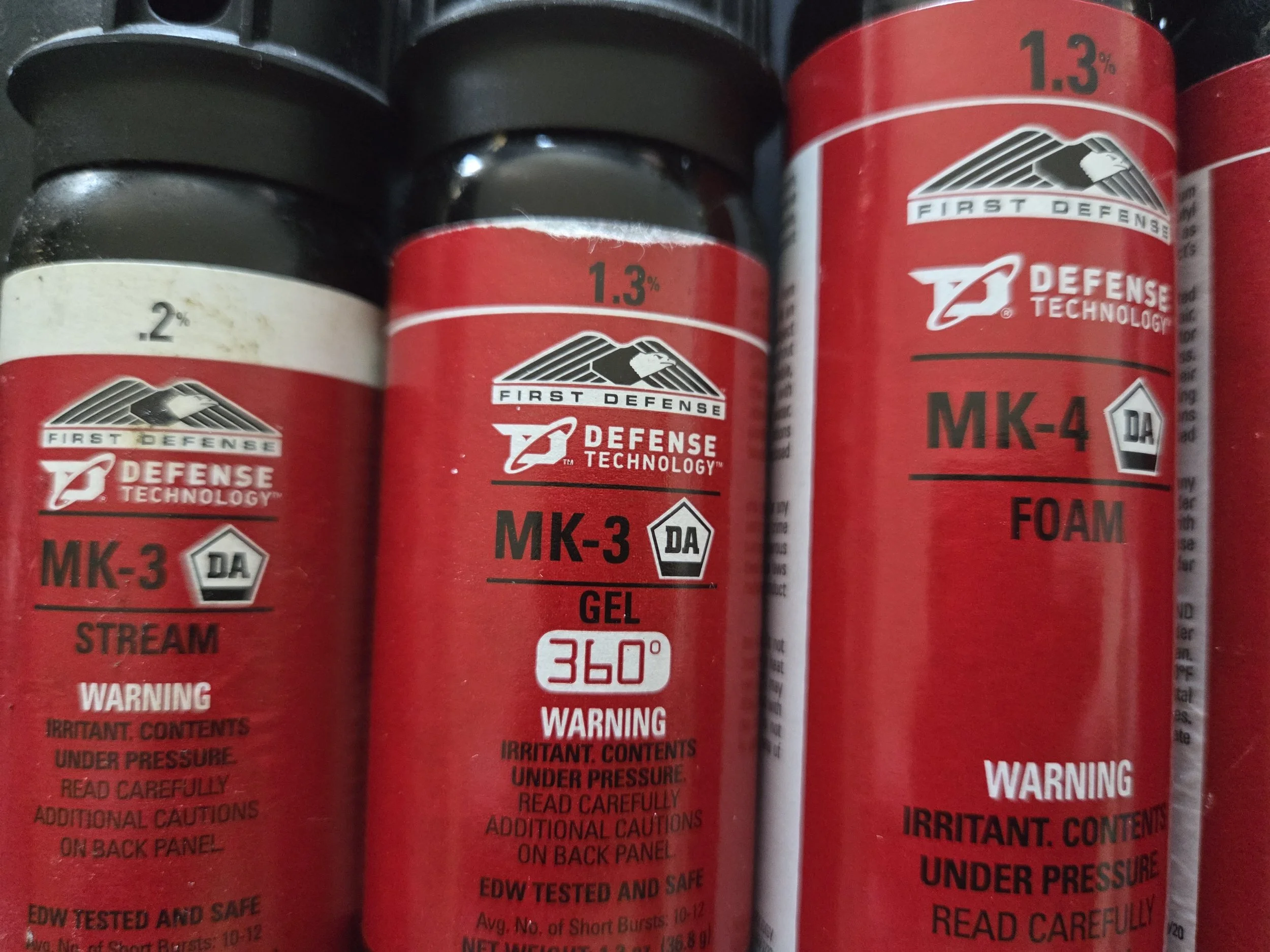
Generally speaking, I prefer First Defense gel, foam, or stream due to their range and the reliability of the product. This is the product you will find being used by LE all over the US. However, if you prefer a different maker for convenience, just be aware that you will need to try out the product to see how it can be employed/deployed.
HOW HOT IS PEPPER SPRAY?
A typical jalapeño pepper registers between 2,500 and 8,000 Scoville Heat Units, with an average around 5,000 SHU that most people recognize as a noticeable but manageable burn. By contrast, First Defense 1.3% does not publish a Scoville rating at all First Defense measures strength solely by Major Capsaicinoid percentage (1.3% MC) via laboratory HPLC testing and explicitly does not recognize SHU as a reliable metric for its finished product. Using the common industry conversion that places 1% MC at roughly 150,000 net Scoville units, the First Defense formula lands in the neighborhood of 195,000–200,000 SHU in the spray that actually leaves the nozzle. That makes the First Defense spray roughly forty times hotter than an average jalapeño on a finished-product basis (or anywhere from about twenty-five to eighty times hotter depending on whether the pepper itself sits at the mild or hot end of its natural range).
The comparison is imperfect because the big multi-million SHU numbers sometimes attached to pepper sprays refer only to the raw extract before dilution, while First Defense reports the more precise capsaicinoid concentration of the completed formula; pure capsaicin itself sits at 16,000,000 SHU, so a 1.3% concentration of that active material produces the intense, short-duration inflammatory effect users feel rather than anything equivalent to simply eating a concentrated jalapeño.
LEGAL USE OF PEPPER SPRAY
Pepper spray, like any other self defense tool is going to fall somewhere in the use of force continuum for the user. Pepper spray (OC spray) is legal for civilian self-defense in all 50 U.S. states and Washington, D.C., but it is not unrestricted. Federal law explicitly carves out individual self-defense devices, including pepper spray, from the Chemical Weapons Convention Implementation Act (18 U.S.C. § 229C), so ordinary civilian canisters are not treated as prohibited chemical weapons at the federal level. States and localities, however, impose their own rules on who may possess it, how large or strong the container may be, where it may be carried, and when it may be used.
The most common restrictions involve intent and use. Nearly every jurisdiction limits lawful possession and deployment to legitimate self-defense against an imminent threat of unlawful force. Using pepper spray offensively, in a mutual fight that has already started, as retaliation, or against someone who poses no immediate danger can be charged as assault or battery. Some states also impose a duty to retreat before using force if it can be done safely, while others follow stand-your-ground principles that remove that requirement when you are in a place you have a legal right to be.
Canister size, concentration, and formulation are frequently regulated. Several states cap the volume of the container (examples include California at 2.5 ounces, Florida at 2 ounces, and New Jersey at 0.75 ounces). A smaller number of states also limit the percentage of active ingredients or restrict or ban blends that include traditional tear-gas agents (CN or CS) in addition to OC. Age minimums of 18 are common, and many states prohibit possession by convicted felons or people with certain violent or domestic-violence convictions. Local city or county ordinances can add further limits even when state law is permissive.
Certain locations are off-limits regardless of state rules. Federal buildings and courthouses generally prohibit pepper spray under 18 U.S.C. § 930 (treating it as a dangerous weapon). It is banned from airport sterile areas and from carry-on luggage; TSA allows one small container (up to 4 ounces with a safety mechanism and limited tear-gas content) in checked baggage only. Schools, courthouses, government buildings, and many private venues also commonly prohibit it under their own policies.
Because rules vary by state and can change, and because local ordinances may be stricter than state statutes, the practical step is to verify the current law in your specific jurisdiction (including any municipal rules) before carrying or using it. In Arkansas, for example, sources indicate it is legal for self-defense purposes under a size limit on the container (with recent legislative updates raising the prior capacity ceiling), but unauthorized possession or use outside the self-defense exception can be charged as a Class A misdemeanor. This is general information only and not legal advice; confirm the latest statutes and any local rules that apply to you.
IT RELIES ON PAIN COMPLIANCE ONLY
Pepper spray functions primarily as a pain-compliance and distraction tool rather than a reliable stopper. The oleoresin capsicum causes rapid inflammation of the eyes, nose, and respiratory tract, producing intense burning, involuntary eye closure, and disorientation for most people. That reaction can interrupt an attacker’s focus, create hesitation or a change in behavior, and open a window to break contact, create distance, and call 911 so that responding officers can take over. It does not guarantee physical collapse or permanent cessation of aggression; determined individuals can continue to act while affected, and the effect is temporary.
Law enforcement and military personnel train specifically to operate through OC exposure for this reason. They anticipate the possibility of collateral contamination, backspray from wind or enclosed spaces, and direct exposure while making physical contact during an arrest or control situation. Their training emphasizes continuing the task despite the pain and visual impairment because operational necessity often outweighs the discomfort. The same environmental and tactical realities apply to a civilian user. Wind, proximity, an enclosed area, or the attacker’s movement can put the spray on the person deploying it. A committed attacker who is not fully stopped may simply become angrier or more focused once the initial surprise fades. For those reasons, realistic use assumes the possibility of partial or full self-exposure and the need to keep functioning afterward.
Because of those limitations, the most practical approach is to deploy the spray from a standoff distance that reduces the chance of blowback while still allowing an accurate stream or gel to reach the face, then immediately create distance rather than remaining in contact. Empty-handed skills remain essential as the backup layer. If the spray fails to produce the expected reaction, runs out, or contaminates the user, the ability to strike, clinch, or disengage without relying on the aerosol is what preserves the opportunity to escape and summon help. Treating pepper spray as one tool in a layered response, instead of a standalone solution, aligns with how it actually performs in the real world.
HOW IT CAN BE USED FOR DEADLY FORCE
Pepper spray is designed and sold as a less-lethal tool whose normal effects—intense burning, temporary vision impairment from involuntary eye closure, and respiratory irritation—are expected to resolve within minutes to roughly an hour after proper decontamination. Wrongful or reckless use can increase the chance of more serious injury, which is relevant both medically and legally when evaluating whether the force applied remained proportional to the threat.
One well-documented risk factor is close-range, direct discharge into the face or eyes. At very short distances the pressurized stream or jet can deliver both the chemical irritant and mechanical force. Medical literature and case reports describe this combination (sometimes discussed in the context of high-pressure liquid jets as a “hydraulic needle” effect) as capable of causing corneal abrasions, punctate epithelial erosions, deeper stromal damage, or scarring beyond the transient inflammation produced by the capsaicinoids alone. Delayed or incomplete irrigation further raises the risk of secondary complications. While permanent vision loss remains uncommon with standard aerosol pepper spray, documented cases of lasting corneal injury, reduced visual acuity, or more severe anterior-segment damage exist, particularly with close-range intentional exposure, certain high-pressure delivery devices, or when the solvent/carrier agents add toxicity.
Other forms of misuse that can elevate outcomes beyond temporary incapacitation include prolonged or repeated exposure in enclosed spaces (increasing respiratory risk in people with asthma or other conditions), use against individuals who are already restrained or otherwise unable to escape the spray, or deployment in circumstances where no imminent threat exists. In legal terms, if the resulting injury is severe or permanent, or if the circumstances show the spray was used offensively rather than in self-defense, the incident can be treated as assault or battery even though the product itself is classified as less-lethal. Courts generally examine whether the force was reasonable and proportional under the circumstances; serious permanent injury from close-range or unnecessary use can undermine a self-defense claim and support a finding that the force exceeded what was justified.
In short, the same product that produces only temporary effects when used at a proper standoff distance and followed by decontamination can, through close-range or otherwise reckless application, produce lasting ocular or other injury. That potential shift is why training materials and product warnings emphasize maintaining distance, using the minimum necessary, and seeking medical attention if symptoms do not resolve promptly. This is general information drawn from medical literature on known risks; it is not legal or medical advice.
WRAPUP
I personally use pepper spray as a self defense tool when travelling and when riding in my vehicle. I also had the training on the use of pepper spray and have had several exposures to it voluntarily and for training. I highly advocate its use as a layer of self defense to give you another tool outside the firearm. Not everything needs a gun, but all self defense can be made easier with the proper use of the right tool.