M&P SHIELD: CONCEALED CARRY BASELINE
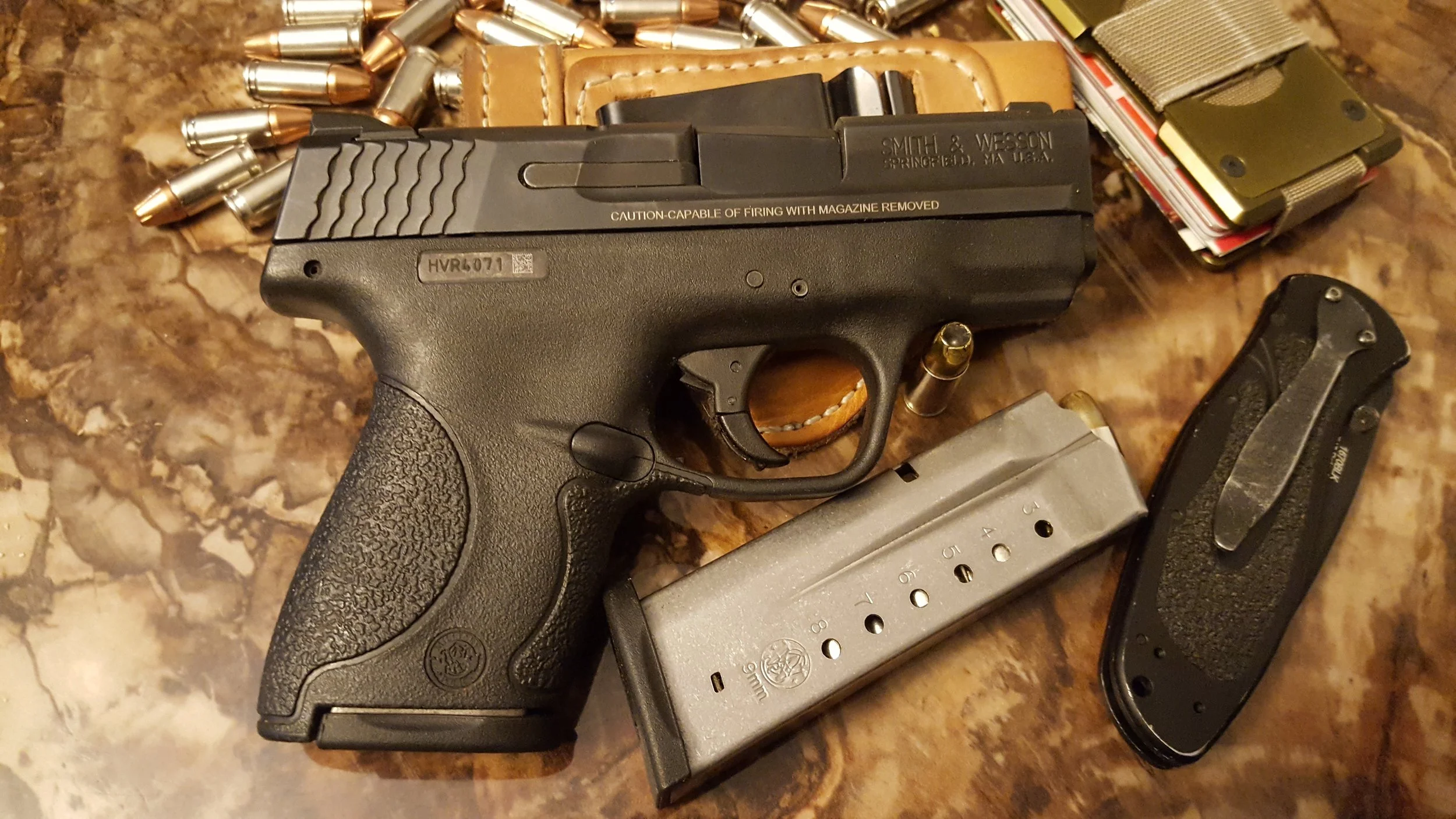
The M&P Shield was a star of concealed carry as soon as it hit the market in 2012. I remember watching the old YouTube reviews of it before trying it out for myself. The reviewers would say it is “a small gun that shoots like a big gun”, which meant that shooting it was not laborious and painful, like most small single stack 9mm pistols at the time. It was also noted as being the most reliable small single stack available at the time. This still reigns true today when you compare the shield against its competitors. It is still considered to be ‘stupid reliable’, and it has been a clear and constantly popular choice for entry level concealed carry. I would argue that it is still the baseline for all other pistols in the ‘micro 9mm’ category.
FEATURES & QUALITIES
The M&P Shield is basically the miniature version of the original M&P pistol. From its’ stainless steel construction to its hinged trigger, the Shield was a very familiar and comfortable pistol to handle, despite its’ small size. The grip was just large enough to allow most people with small to medium sized hands to get a full purchase with the flush fitting magazine. However, the pistol came with a spare magazine that featured a removeable extension and an extra round of capacity.
TRIGGER
The Shield was the first pistol in the M&P line to feature a tactile and audible reset. Though, gun critics still found fault in the little M&P trigger for having a relatively heavy weight of pull compared to a stock Glock, it was still considered very comfortable and easy to shoot well. The trigger on the M&P Shield is the same style as the larger M&P pistols. It features a 98% pre-cocked when fully in battery. When the trigger is pulled, the trigger bar presses against the forward part of the sear, causing the sear to cam down against a sear spring, slightly cocking the striker before finally releasing it to strike the primer at full force. WATCH THIS VIDEO to see how it works in an animation. WATCH THIS VIDEO for a detailed walkthrough on how it works.
RECOIL CONTROL
The M&P Shield won many hearts with its’ impressive ability to manage recoil in its Zytel (Nylon), stainless steel-reinforced frame. Reviewers raved about how it was one of the few small 9mms on the market that could be taken to the range and shot all day without beating the crap out of your hand. In my experience, the reason this pistol handles recoil so well has to do with the nylon and metal frame.
NYLON FRAME
I would go as far as to say that 60-70% of what we consider to be ‘RECOIL’ is actually just excess vibration leftover from the slide smacking the frame. The stainless steel chassis molded into the frame acts as a matrix that absorbs excess vibration, compression, and torque from the recoil forces. You have a slide that is slamming against the frame, directly into a exposed piece of stainless steel, and then the Zytel frame is just flexible enough to absorb the excess vibration before it gets to the hand. Nylon is lightweight, versatile, and very good at absorbing impact forces. Nylon is used in H&K pistols to absorb excess recoil and lower the peak force sustained by the frame. By comparison, the minimal metal supports in the first four Generations left much to be desired as far as felt recoil mitigation.
VERSATILITY
The Shield comes in 9mm, .40 and .45, and has a very wide range of options for the users in all 50 states. Whether you live in ‘occupied territory’ like Commie-Fornia or Mass-A-Communists, ‘No Hope’ New York, or ‘What-A-Waste’ Washington, the M&P can be acquired and serve you with fidelity.
For those who want a safety, you can easily get a model that has an unobtrusive safety lever. There are also models that offer you a trigger disconnect like the classic Browning Hi-Power, if you are concerned with a pistol firing without a magazine inserted. In the Massachusetts-legal version, you even have a loaded chamber indicator that protrudes on the top of the slide, as is required by the draconian gun laws in that state. Regardless of whether any of these versions are required, you can find a version of the shield that you want, and that can suit your needs the best.
ADDITIONS TO THE FAMILY
In 2012, the original Shield took the market by storm, despite being a relative newcomer. Its qualities shined through and it quickly built a track recoil for being affordable, reliable, versatile, and user-friendly.
In late 2017, after a huge success in the release of the 2.0 series of M&Ps, Smith & Wesson released the Shield 2.0 series. This version added a lighter trigger system, more comparable to that of the M&P Pro, along with added front slide serrations and a redesigned grip texture that bites into the hand nicely. Internally, the rails were beefed up and the steel reinforcements were strengthened to add even more durability to an already durable platform.
Then the Shield Plus entered the market in 2021. This version of the M&P Shield is supposed to be S&Ws’ version of the Sig P365. It has a 10 round capacity in the same size package of the Shield 2.0, but now features a flat trigger that makes this system an almost completely different shooting experience. However, the foundation of these additions is the already proven and reliable Shield platform. Many of the parts are interchangeable, and even the recoil springs are all the same. For the most part, all the high wearing parts are interchangeable across the different generations.
STILL THE CONCEALED CARRY STANDARD
If I am asked today what someone should buy as their first pistol, regardless of price, I will undoubtedly tell them to look at the M&P Shield lineup. They are a domestic product, have terrific holster options, are affordable, durable, easy to shoot well, and they are just an icon for a dependable firearm that the layman can depend on. But, of course that is my own opinion based on shooting several thousands of rounds out of my M&P Shields with next to zero issues.