REMINGTON ULTIMATE DEFENSE 180GR: A HIGH PERFORMER IN TESTING
The Remington Ultimate Defense is quite obviously a repackaged Golden Saber. What many people don't know is that there were minor improvements to the Golden saber design in the form of altering the lead content in order to get it to the right ratio for the desired results to be consistent through a variety of velocities/barrel lengths.
HISTORY OF THE GOLDEN SABER
The history of the Remington Golden Saber bullet begins in 1991 when Remington introduced it as a premium defensive handgun ammunition designed to meet the stringent requirements of the Federal Bureau of Investigation (FBI). The bullet was conceived by Remington's bullet engineer, Dave Schluckebier, who had previously worked at Winchester and developed the notorious Winchester Black Talon. Schluckebier's design for the Golden Saber featured a reverse-jacket construction, where the jacket was drawn from the base forward, and a core was inserted from the nose. The jacket was made from cartridge brass (70% copper, 30% zinc), which offered greater stiffness and higher yield and tensile strength compared to the more common gilding metal. To ensure the bullet met FBI testing standards, which involved firing into heavily clothed gelatin, Schluckebier incorporated unique features like a driving band at the rear of the bullet to reduce bearing surface and improve alignment, and spiral nose cuts to promote wide, reliable expansion while maintaining weight retention and deep penetration.
In 1992, Nick Sachse joined Remington and was tasked with improving the already highly regarded Golden Saber. His solution was to bond the brass jacket to the lead or lead-alloy core, a technique that was not common at the time. Sachse discovered that a pure-lead core was necessary to prevent voids during the bonding process and had to reengineer the driving band formation. This bonded version, introduced in 1998, significantly reduced the rare instances of core-and-jacket separation, especially when penetrating tough barriers like sheet steel or auto glass. However, Remington restricted the sale of the bonded Golden Saber to law enforcement agencies, citing cost and performance concerns.
Recognizing the need for a high-performance, non-bonded alternative that was more affordable, Remington promoted Sachse and tasked him with another improvement. He enlisted engineer Jason Imhoff and sought the expertise of handgun bullet designer Tom Burczynski. Their solution was the "Black Belt" design, introduced in 2014, which featured a mechanical locking system called "Mechani-Lokt". This system used a black, nickel-plated belt made of the same cartridge brass as the jacket, placed around the mid-section of an hourglass-shaped lead core, effectively holding the core in place without the need for chemical bonding. The Black Belt bullet was engineered to meet FBI requirements and was initially released to law enforcement before becoming available to the general public in calibers like 9mm, .40 S&W, and .45 ACP by early 2015. The design aimed to provide bonded-bullet performance at a lower cost, with features like spiral nose cuts ensuring reliable expansion even from short-barreled handguns.
JACKET SEPARATION
When we look at jacket separation in bullets, we usually see that this causes the bullet to lose weight, which theoretically decreases the momentum the bullet has, and therefore can reduce the penetration. The Golden Saber design absolutely does have an issue with frequent jacket separation. However, the Golden Saber has proven to not shed its jacket until the bullet has already penetrated to a critical depth of over 13-15 inches. In most cases, the jacket only separates an inch or two behind the core, if not staying on it until the bullet is extracted. This has been proven through many shootings and tests. So in my opinion, when used for self-defense, the traditional Golden saber design is one of the best performers that still holds its own when compared to the current competition.
TEST MEDIUM
Now that the history and issues are out of the way, let us talk about the test results in the meat target. First thing I want to discuss is the testing format. The target that the bullet would encounter in order is a layer of cotton hoodie, a layer of cotton t-shirt, pork chops, pork ribs, watermelon, pork ribs, a layer of t-shirt, and a layer of hoodie. I used a few rolled up towels to act as a backstop for the target, just in case.
SKIN, MUSCLE, AND BONE
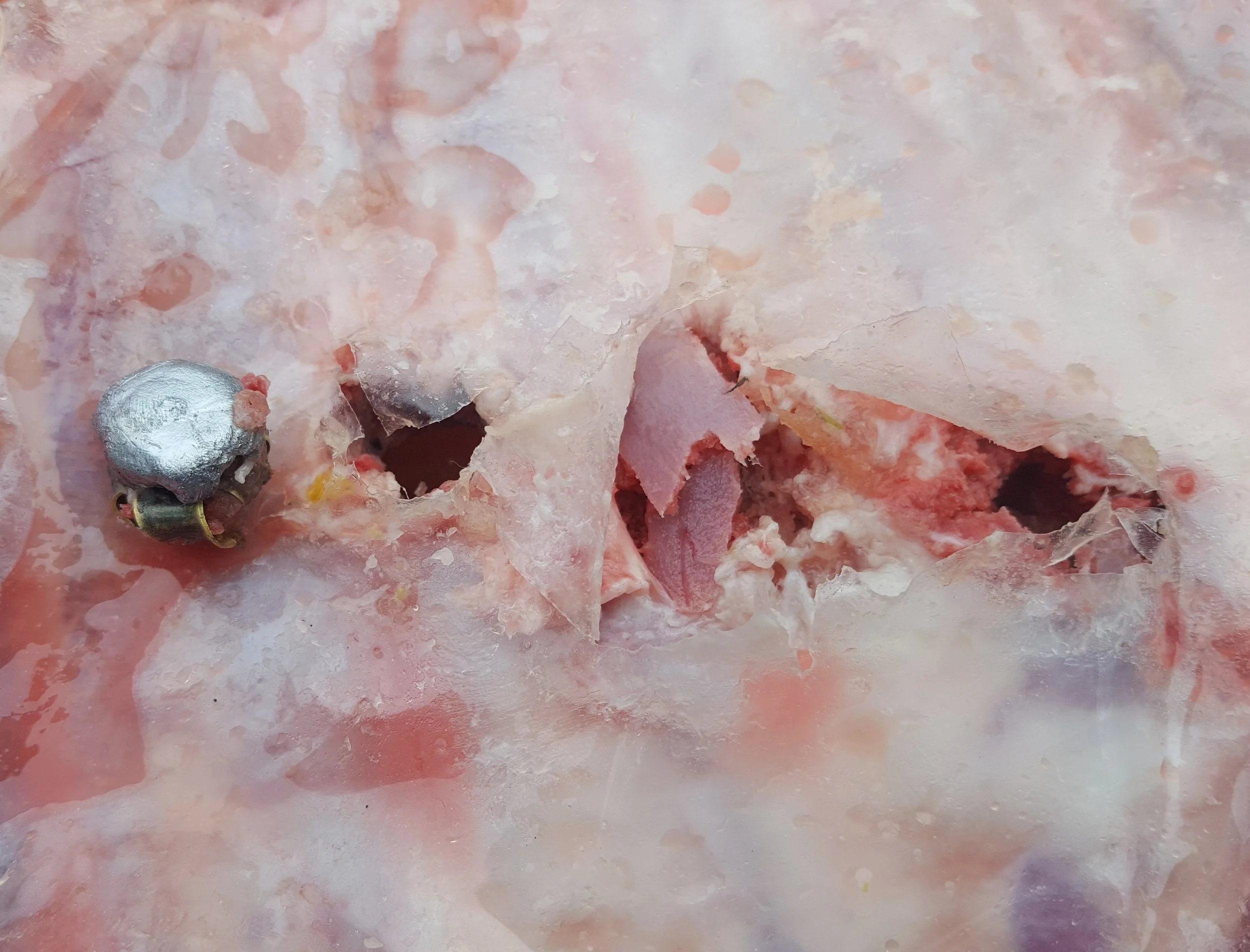
The first thing I want to show is the pork ribs and the size of the holes. These holes indicate that the bullets had already expanded, perhaps completely, by the time that they hit the ribs. The brass jacket of the Golden Saber is supposed to delay expansion as long as possible in order to facilitate expansion. It would seem that this bullet expanded at least halfway through the pork chop. This is slightly different from the other ammunition that I have tested. Usually, I see a whole lot of damage to the pork chops and then it carries over to the ribs and watermelon. It is what it is, but I will note that the pork chops were still partially frozen, which could reasonably cause the bullet to expand earlier due to the heavier and more resistant water-based medium.
LUNG TISSUE
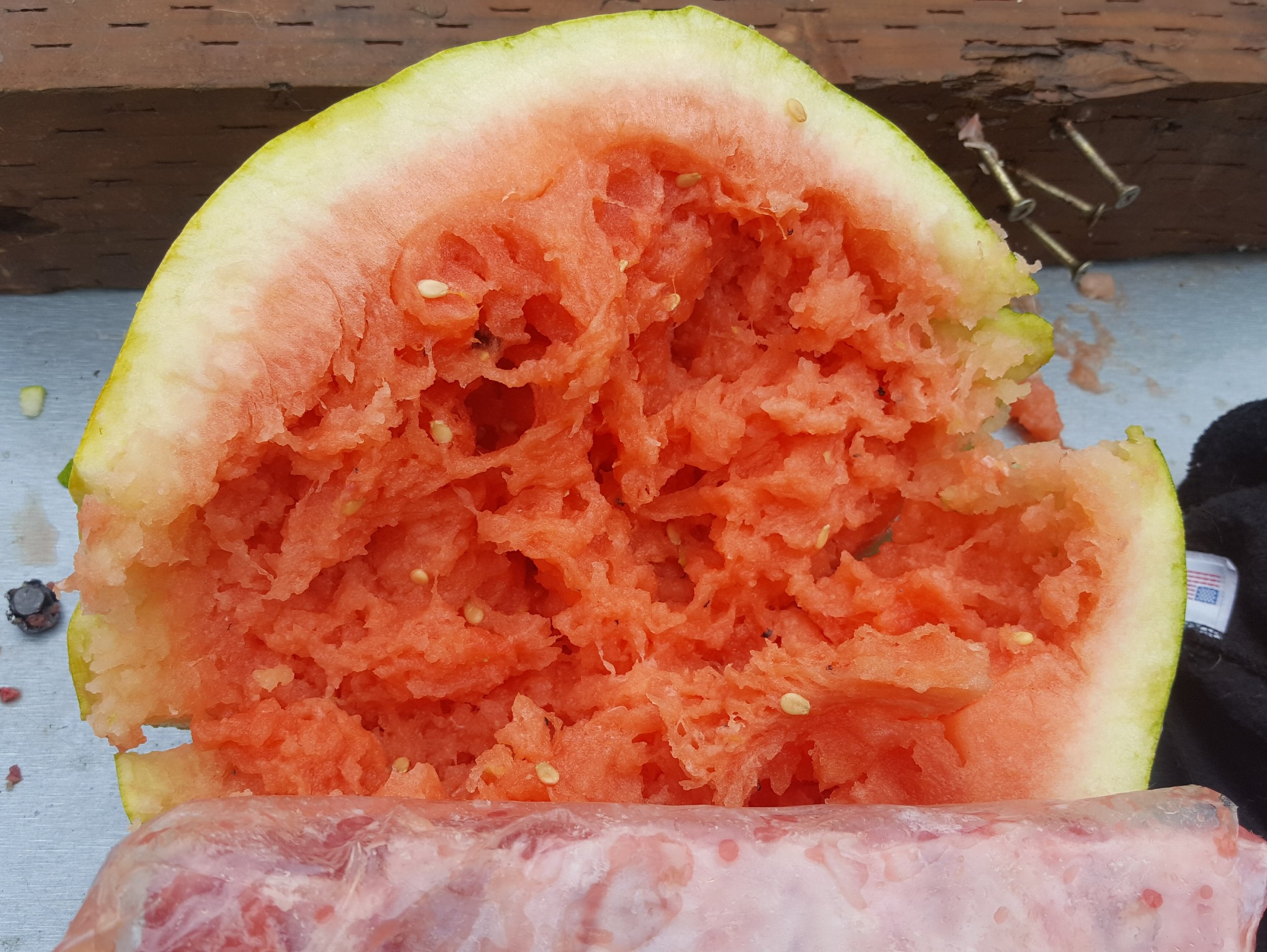
Now when we look at the watermelon, I will note that the limited damage to the watermelon could very well be a result of the pork chops, which affected the damage caused to the ribs as well. Just as a note though, the Winchester White Box JHP actually caused the most damage to the watermelon, and the whole target for that matter, compared to all the other rounds I have tested. However, I will say that the damage inflicted to the watermelon by the Golden Saber is on par with the damage done by the Sig 165 grain V-Crown and the Remington 180 generic JHP. However, I would like to not that both of those hollow point bullets did not fully expand until they reached the watermelon. This conclusion was reached by evaluating the target and finding that the ribs were darn near annihilated by the shock of the expanding projectiles. With all that said, I think the Golden Saber did very well on carrying the damaging shock through the target consistently, despite the added challenge of a frozen pork chop working against it.
RESTING POINT
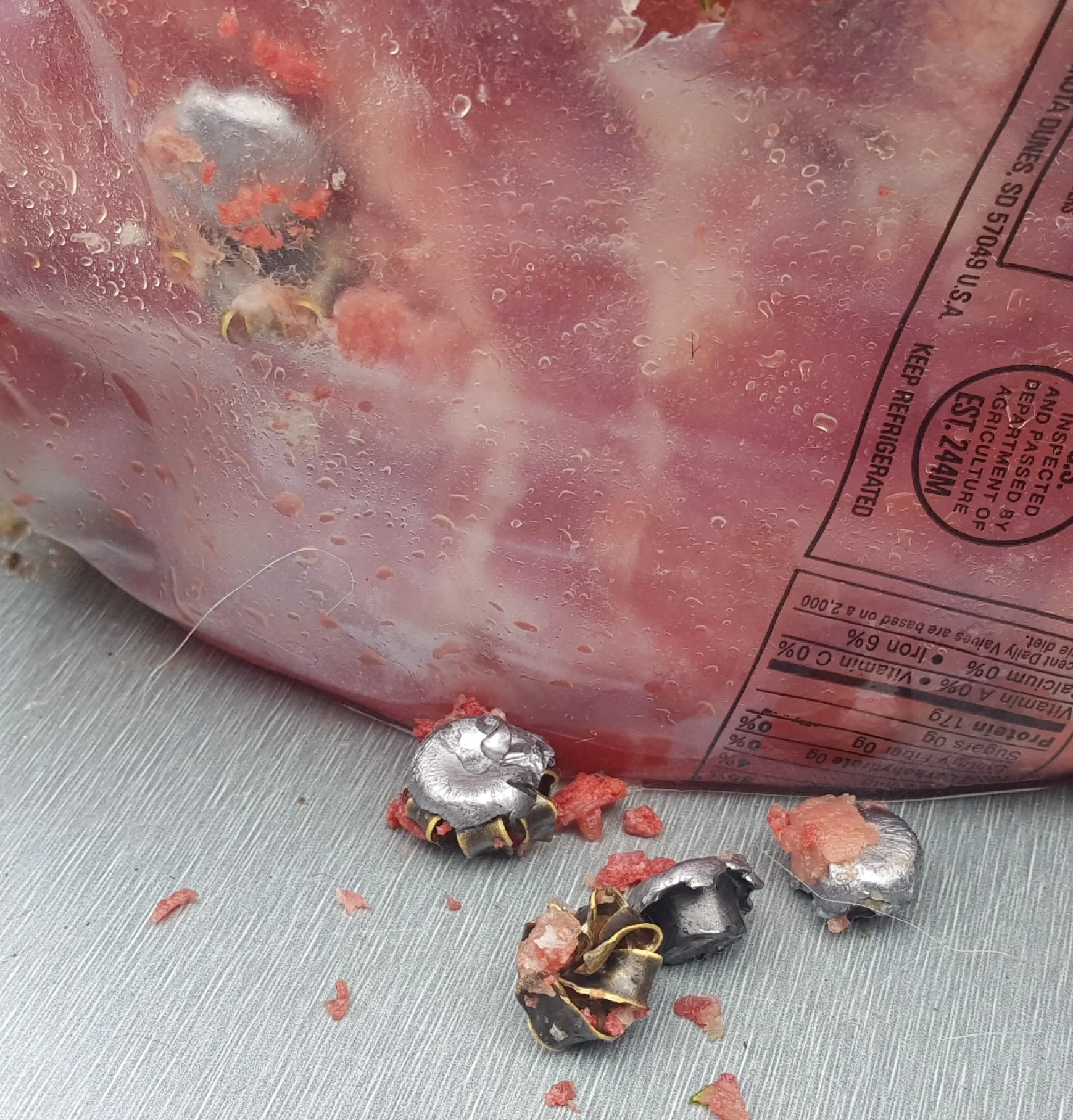
Last part of the target that I want to cover is where the bullets came to rest. Three of the four bullets actually were resting in and actually stuck in the t-shirt. This means that the bullets had 100% penetration, and it was incredibly consistent. One bullet was not able to muster the energy to push through the ribs and defeat the plastic wrapping on the back, but it was close. One of the bullets had lost its jacket at the front part of the back ribs while the rest of the bullets retained their jackets all the way through the target to the resting point. Upon lifting the shirt, the bullets fell and separated from their cores. Only one bullet retained its jacket securely. As you can see, the concern of jacket separation is often dramatized through stories and shown dramatically in ballistics gel, which is not really a realistic medium for evaluating real world performance of bullets hitting various mediums like skin, bone, fat, muscle, etc. in concert.
WRAPUP
The Golden Saber has a good record of performance in the real world of going to critical depths in the target and delivering a lethal blow as it was designed to. I don't think I know of another "hyper-ammunition" that I trust more. If you are really concerned about getting the best performance out of the Golden Saber and retaining the jacket no matter what, I recommend getting the bonded version of the bullet. Other than that, I think that the Ultimate defense is a great bullet, and at $20 for 20 rounds on average, you are getting a good value as far as 20 round boxes of hollow points is concerned. However, it would appear that Remington is looking to kick this ammo line off the market in favor of their new Black Belt line of ammunition. That ammunition comes with all the advantages of the bonded ammo and may be a step in the right direction for the Golden saber to come into the 21st century in a strong way.